Salvation Story: Saved From Hell

Oh, my!!!

And here I thought that throwing in this extra week in our Salvation Story about being Save From Hell would be “easy” and “fun”… This message has been Hell to create.

Why? Maybe because I am now keenly feeling the Hell of what my life is like during this pandemic? Maybe it’s because I, like most people in this day and age, don’t believe in a Hell after we die. Dante’s nine circles of Hell that he wrote about in the 14th-century don’t really resonate with me and my enlightenment thinking in the 21st-century. And, I don’t have to look very hard today to see the Hell on earth that we human beings have created for ourselves and for each other.

Maybe this has been so hard because the Hell on earth right now is so…very…Hell-ish. I hope we are all honest with ourselves and even more than that, really taking the time to look out on a creation that is groaning with labor pains – which Paul writes about – a creation waiting…for us.

And I find that helpful. Paul is working with the metaphor found in Genesis where by eating from the Tree of Knowledge of Good and Evil Adam and Eve set this mess in motion. God cursed the ground because of their action. It is this ground that is groaning according to Paul. And oh how we hear the groans because we now know good and evil. We know Hell. And it is here.

Several years ago I wrote a weekly religion column for the Noblesville Daily Times.  Every week a word or two on something religious, ethical and/or philosophical.  And then every Monday I would have at least one maybe two emails in my inbox telling me that I was going to Hell.  Some were nicer than others whereby the sender indicated that they would be praying for my soul.  I suppose I should be grateful for her or his pray but then I got to thinking about the sheer audacity and arrogance of someone thinking that her or his prayer could save my very soul.  Tell you what God can handle the endpoint for my soul without your prayer.  So, I wrote a column about that thought and guess what…

I wrote a column suggesting that some biblical practices condemned as sinful were more about the times and cultures of that tie than about morality and God’s will.  Guess what?

An aside: Isn’t it interesting that those who seem to be the most vocal and most sure about the soul of another going to Hell also carry with that judgment the idea that her or his soul is headed in the more upwards direction?  I could guess what my inbox would contain if I wrote a column reflecting upon that observation…

If the number of messages in an inbox saying, Go to Hell, is indicative of one’s chance of actually going to Hell, well…Hello, Hell!

Hello, Hell. Which brings me to Eric’s Helpful Hints to Hold-off Hell. And I use the words hold-off as way to say avoid with an H-word so I could gain some rhetorical power with alliteration in my title, “Helpful Hints to Hold-off Hell.”

First, remember my first sermon to you where I said, “Hello!” And I indicated what happened when you drop the “o” from “Hello”? Hint number one: Always say, “Hello.” When you don’t you create Hell.

The next seven hints come from Christian tradition beginning with the 4th-century desert father, Evagrius Ponticus, who was the first to enumerate what became known as the Seven Deadly Sins. It’s a good list. A great list.

And as I quickly run through this list keep in mind that these seven deadly sins come out of seven basic needs of the human being. Those needs become sins, deadly sins, when we make those needs all-consuming. When we become addicted to a particular need. Or when we become blind to the effects our needs are having on those around us.

With that said, here’s the list:

Lust
Gluttony
Greed
Sloth
Anger
Envy
Pride

As I say that list once again, which of them creates a bit of heat under your seat.

Lust
Gluttony
Greed
Sloth
Anger
Envy
Pride

Lust. Uncontrolled desire. Physical. Sensual. Spiritual. So very much a hallmark of our consumer-driven society. How difficult has it been for you to be holed up at home unable to go out and shop? Lust.

Gluttony. How much stuff do you really need to be a human being that lives for the sake of other human beings? I would suggest that we are not gluttons for punishment. We are gluttons of stuff.

Greed. Gimme. Gimme. Gimme. Sure we all need the basics. But some need more. And worse. Some need what others have.

Sloth. I am so lazy I am not even going to take the time to explain sloth. Back to my video game.

Anger. It’s that reptilian response of fight type anger that is dangerous. I have shared before how in our study of Joy with the Dalai Lama and with Archbishop Tutu how important it is to create space and time between a stimulus that…creates anger…and our response. It’s the immediate response that is dangerous and destructive.

Envy. The classic example of Cain killing Abel. Somehow we get it in our minds that God loves another more than God loves us and WATCH OUT, malice is soon to follow.

And finally, Pride. The BIG ONE. Throughout Christian history Pride has always had the pride-full place of being number one on the list of the seven deadly sins. Oh, how pride conceals itself so very, very well. I am not racist. I earned my living. I pulled myself up by my own bootstraps. I deserve what I have. I worked hard for my way of life. AND, my way of life and my religion and my sense of well-being is right. And, here is a real sneaky one: God has blessed me. I don’t often quote from America’s first and foremost fire-and-brimstone preacher, Jonathan Edwards, but he puts pride in it’s place 400 years ago when he says, “Remember that pride is the worst viper that is in the heart, the greatest disturber of the soul’s peace and sweet communion with Christ; it was the first sin that ever was, and lies lowest in the foundation of Satan’s whole building, and is the most difficultly rooted out, and is the most hidden, secret and deceitful of all lusts, and often creeps in, insensibly, into the midst of religion and sometimes under the disguise of humility.” Oh, my…sweet, sublime Rev. Edwards, grandfather of Aaron Burr, who ironically, was unable to realize IN HIS PRIDE that the world was wide enough for Hamilton and I.

Interestingly enough, pride, the most difficult to root out, the most hidden, secret and first sin, is right in front of us, looking at us in the mirror in which we are looking at ourselves. When we look in that mirror and see me, myself and I, or when we look in that mirror with others and see us, ourselves and we, how quickly we create Hell. Or, how quickly we go to Hell.

Believe it or not. There is a simple way – which is a theological way of saying, A very difficult way – to avoid Pride as a deadly, deadly sin. And it also works for the other deadly sins. And that is, my high school English teacher would love me for this, Pronoun Usage. If in your Facebook posts, and conversations with those around you and in your neighborhood and your community, you are using me, myself, and I and using us, ourselves and we, pause. Is that who God is seeing and loving and pouring out compassion upon?

Sometimes I point out that Jesus lived and died to show us proper pronoun usage and to give us one helluva chance to stay out of Hell. Jesus was constantly for the Other; healing, teaching, feeding and eating and drinking with the other. Jesus died not for himself but for everybody else. God so loved the world. And I may approach a bit of heresy here – and my email inbox will probably fill up – but we turned what Jesus did for Others into believing that Jesus did whatever Jesus did…for US. When Jesus was giving us an example, his very way of life AND his very life, to show us how to bring heaven here on earth for the other by living and dying for the other. And we turned that into having faith that Jesus died for us to save us from Hell.

Is it any wonder that spiritual master after spiritual master all say that when she or he dies they want to go to Hell? The Dalai Lama and Archbishop Tutu say that very same thing in the Book of Joy. Because the compassionate and loving response to the gift of life is always to go to where there is no life. If there is Hell on earth, go and work to bring heaven to that place on earth. And then in death, if there is Hell in Hell, to go to Hell and save everyone.

I consider that the sufferings of this present time are not worth comparing with the glory about to be revealed to us. – Romans 8:18

You,
Who suffered on the cross
- some say for our sakes, for my sake -
and died.
Tell me how the point of a nail
through the wrist
compares
to my demon's daily grind and grinding
of this present time
which followed the grind in the present time of a moment ago
and, if all Hell doesn't break loose,
will be followed by the grind in the next moment in time?
A comparison with future glory is necessary
to keep considering
the sufferings of this present time.
Amen.

Salvation Story: Saved From Meaninglessness

We are all familiar with the story of Alice in Wonderland; if not the book titled Through the Looking Glass, then with the Disney movie version Alice in Wonderland.  Alice follows a strange rabbit who keeps looking at his timepiece declaring, “I’m late.  I’m late for a very important date!”  Following this strangely dressed creature, down the rabbit hole Alice goes!  She encounters all sorts of strange creatures.  “Curiouser and curiouser!” cries Alice.  “Dear, dear!  How queer everything is to-day!  And yesterday things went on just as usual.”

The story of Alice is a story about meaning.  The unexpected appearance and disappearance of the Cheshire Cat appears to be meaningless.  In the field of mushrooms, she is asked by the Caterpillar, “What do you mean by that?  Explain yourself!”  In the final scene, a judgment scene, Alice stands before the king and queen of hearts.  The Queen, uninterested in anything Alice has to say, declares, “Off with her head!”  Alice replies, “No, no.  That’s not what I mean.”  And then the tiny little king jumps in and happily declares, “If there’s no meaning in it that saves a world of trouble, you know, as we needn’t try to find any.”  Eventually the house of cards collapses in silliness and Alice finds her way back to her own world, as if no time at all has passed by. 

“If there’s no meaning it,” declares the King, “then that saves a world of trouble.”  Think about it.  The king gets it backwards.  For him, the lack of meaning saves.  How easy it is to be king when, if no matter what you do, or do not do, there is no meaning.  That makes ruling an empire pretty easy.  If what you say as king rules the day, then you are accountable to no one but yourself.  And, to heck with all of your subjects, even if they are all just cards to be played and ordered about.

I describe this courtroom scene and the role of the king and queen of hearts because THIS is the type of kingdom, or empire, that the people of Jesus and Paul’s time lived in.  They were at the mercy of the powers-that-be.  Cards to be ordered about as slaves and serfs and workers.  All of their meaning came from Caesar and from the minions under Caesar: governors, Pontius, tax-collectors, centurions, and temple priests.  Rise with the sun.  Do your appointed work.  Eat if there was food.  And collapse into sleep when the sun went down.  Everyone in their place.  No interaction between free and slaves beyond commands of, “Do this!” or “Do that!”  No interaction between Gentiles and Jews.  Women knew their place and could speak only when spoken to.  The culture of the Roman Empire and the culture of the religious community at that time was Law.  And it was the Law that provided meaning to everyone.

Into this environment comes a man, short of stature, a bit ugly, and slow of speech, who brings a radical message.  A message of salvation!  Of salvation from the power and control of the Empire’s meaning-making systems. 

NRS Galatians 3:23 Now before faith came, we were imprisoned and guarded under the law until faith would be revealed. 24 Therefore the law was our disciplinarian until Christ came, so that we might be justified by faith. 25 But now that faith has come, we are no longer subject to a disciplinarian, 26 for in Christ Jesus you are all children of God through faith. 27 As many of you as were baptized into Christ have clothed yourselves with Christ. 28 There is no longer Jew or Greek, there is no longer slave or free, there is no longer male and female; for all of you are one in Christ Jesus.

“You don’t have to live like this,” Paul declares.  “There is a better way.  The Way of Christ!”  Imagine the thoughts of those 1st century folks who heard Paul’s message for the first time.  Scratching their heads, looking at each other, saying, “What in the world does this mean?”

It is hard for us in the 21st-century modern world, especially in America where WE are free.  Free to do what we want, when we want to do it.  Free to make our meanings.  While this message of salvation may not sound so significant today, I say that it is this very message of salvation that was THE most powerful message of salvation for those 1st century people.  And while it doesn’t sound too subversive today, once Paul’s listeners figured out what Paul meant when he said, “We are no longer subject to the disciplinarian,” then, my guess, is that eyebrows were raised, maybe some eyes began to twinkle, and fear…fear grew in the hearts and minds of those listeners.  Because they knew who and what the disciplinarian was and what happened to those who didn’t listen to the discipline of the Law of the land.

Paul never let his congregations forget about the disciplinarian.  Paul declared over and over again, “We preach Christ crucified!”  Notice Paul didn’t say, “We preach Christ crucified for us!”  No.  Paul preached, “Christ crucified,” to constantly remind his followers that it was the disciplinarian, Caesar and Rome, the priests in power and the Temple-system, those who followed the Law, that crucified Christ.

Paul preached and wrote letters to the people in the capital cities of Roman provinces.  He preached to the poor, urban folk.  Mostly to slaves and serfs, occasionally to people with a bit more power.  These folks were helpless.  Their lives had no meaning.  So to get us into their sandals, let me try and place Paul’s message into our lives today. 

Into Kokomo or wherever you may reside strolls Paul.  He gathers us around him and begins talking.  “People of Kokomo, let me tell you of a Way where you can live meaningful lives.  But before I do that, let me tell you where meaning does NOT come from.  It does not come from the lawmakers in Washington, D.C.  It does not come from the preachers and pastors in the houses of worship.  It does not come from the rich and the powerful.  It does not come from the talking-heads on television, on the radio, or on the internet.  It does not come from political slogans or from advertising jingles.  It does not come from all the distinctions that are made by the American way of life that separate the haves from the have-nots, the men from the women, the white collar workers from the blue collar workers, the rural folks from the urban dwellers, the elderly from the eternally young nor the black from the white nor the yellow from the red.  Meaning is not born in Hollywood nor financed by Wall Street. 

“You do not need to be subject to these laws and the disciplinarian that seems to control this web that you are caught in.”  And then Paul shifts direction with a smile of deep care and love on his face.  “In Christ, there is a still more perfect way.  There is no longer Jew or Greek, Muslim or Christian, there is no longer slave or free, Mexican or American, there is no longer male and female. there is no longer black or white or red or yellow; for all of you are one in Christ Jesus.”  A radical message.  Yes?  Just as radical today as 2,000 years ago.

What meaning do we take away from this for our lives today?  For me it’s pretty simple.  We are ALL God’s creatures.  We are ALL loved by God.  No one more loved by God.  No one less loved by God.

So what are we to do with this message today?  Paul’s letter to the Galatians is his nastiest letter of all of his letters that we have in scripture.  Remember the line: “You foolish Galatians!  Who has bewitched you?”  And my favorite line: “I wish those who unsettle you would castrate themselves!”  Paul is really upset because the Galatians are falling back into the ways of the Law, being controlled by the powers-that-be of Rome and Temple, being manipulated by The Matrix. Influenced and cajolled Fox News and Fake News. Satisfied with $1,200 while corporations reaped 84% of all COVID relief funds. Willing to accept a level of death and casualties so long as we can go on living our way of life.

So what do we do to free ourselves?  Remember Paul’s words from last week? “For you were called to freedom, brothers and sisters; only do not use your freedom as an opportunity for self-indulgence, but through love become slaves to one another.”  He goes on, saying the very same thing that Jesus said just a few years before, “For the whole law is summed up in a single commandment, ‘You shall love your neighbor as yourself.’”  And how do we act out this love for each other and for our neighbor?  Paul finishes his letter to the Galatians with this simple instruction: “Bear one another’s burdens, and in this way you will fulfill the law of Christ.”

So how does Christ save us from a life of meaninglessness?  How do you feel when you relieve another person of a burden?  How do you feel when you touch the life of another, even in some small way?  How do you feel when you serve a need of a person with many needs?  A family member.  A church member.  A neighbor.  A stranger.  An enemy?  Elie Wiesel, holocaust survivor and Nobel Prize winner, writes, “It is in combating the suffering of others that we find meaning in our own.” I end with Paul’s closing words to the Galatians, “As for those who will follow this rule (bear one another’s burdens), peace will be upon you.” In theological language, you will find your salvation by saving another. In Jesus’ words, salvation is found in seeing the hungry and giving them food. Giving the thristy something to drink. Welcoming a stranger. Clothing the naked. Visiting those in prison. And, deeply resonant with our own time, taking care of the sick.

Saved. And, your life will be filled with meaning.

Therefore the law was our disciplinarian until Christ came, so that we might be justified by faith. – Galatians 3:24

Christ,
Eternal with God,
the beginning Word,
through which the Law
came into being,
begotten, not made,
breaking yourself apart
as an example
to discipline your disciples,
saying, You feed them,
feed us
again.
Jews and Greeks,
male and female and other,
struggle with each other,
against each other,
for each other,
as the Law disciplines
again
with each other against each other.
Amen.

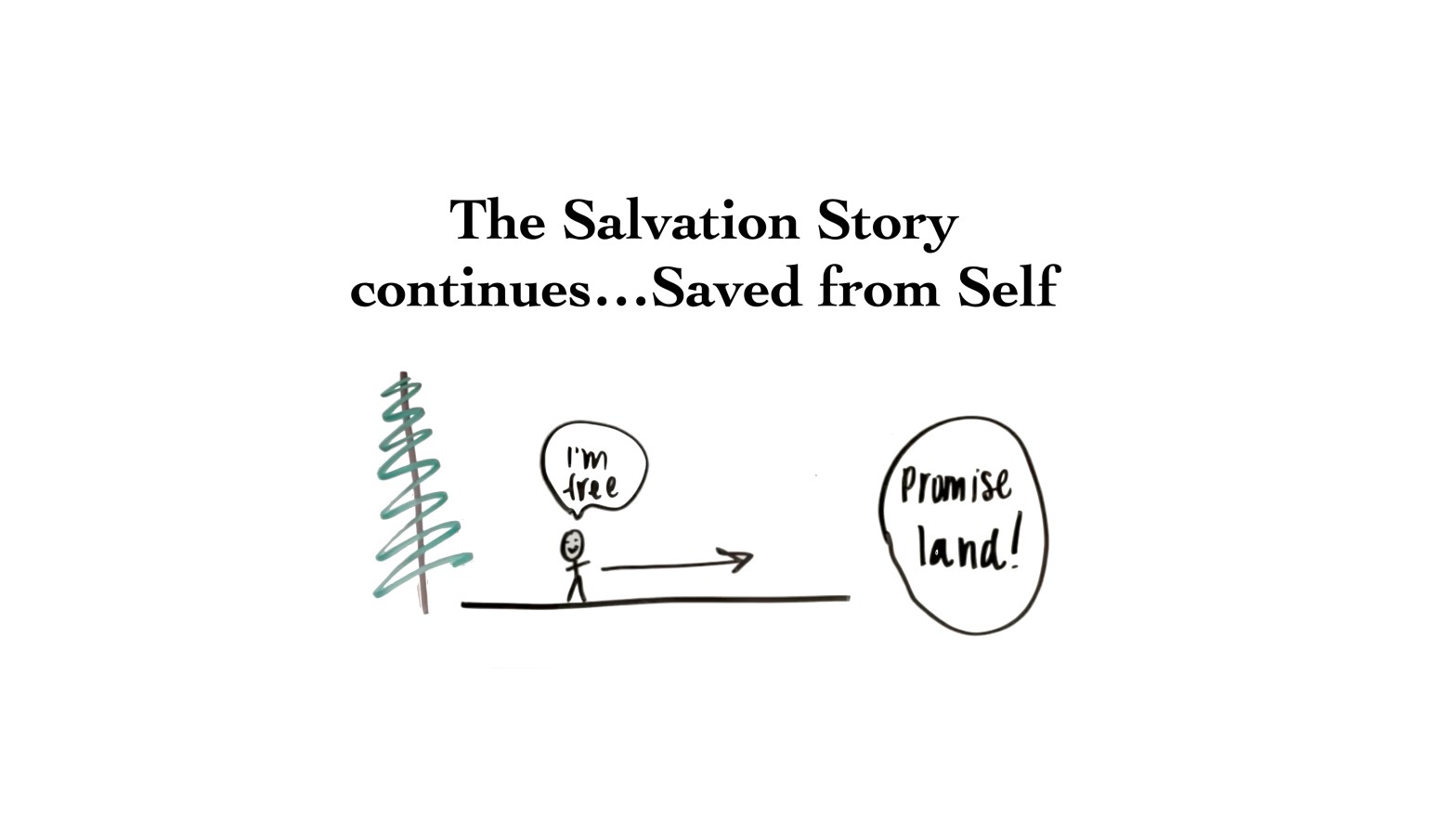
“Salvation Story: Saved From Self”

I am a free person until the dessert menu appears. Once the chocolate ganache cake is finished and I have freely licked the plate clean, I am once again free.

I am a free person until I get the call that a daughter has been hospitalized. After seeing her in the emergency room, her feeble smile and getting to hold her in my arms, I am free to breathe again.

I am a free person.  I can leap off the tallest parapet in the land…though gravity works.

I am a free person.  I shop at Meijer, Kroger, Fresh Thyme, Whole Foods and I miss my Marsh.  At each store the children’s cereals are all in the Cereal Aisle.  And each colorful, children’s cereal box is at the level of my naval.  I suppose I am free to grab my favorite, Apple Jacks, Family Size, but my physician and others have indicated that a cereal with a bit more bran would be more helpful for my body.

I AM a free person if not for my body.  Which thirsts.  Hungers.  Grows tired.  Needs to breathe.  And, fortunately, my body is ABLE to function in a world designed for fully-ABLED bodies to function in.  Though I am finding some doors more difficult to open at my age.  “Dad, the sticker says, push.”  Of course it does, daughter, I was simply checking to see if the door could freely swing both ways despite the label.

I am free.  Though the idea of some of these scientific discoveries which state that the state of the ittiest of bittiest pieces of my body are simply flying all over the universe and against my will is…troubling.  It is like being a fifty-five year old man who is conscious of limiting the amount of fluids he drinks after 6:00 p.m. and still has to get up in the middle of the night to use the bathroom.  Troubling to my sense of freedom.

I am free but I also puzzle about God’s plan like the poet Linda Pastan.  She writes in her poem, “On the Question of Free Will,”

Sometimes,
noticing the skeleton
embossed
on every leaf

and how
the lion’s mouth
and antelope’s neck
fit perfectly,

I wonder
at God’s plan
had Eve
refused the apple.

Sometimes, I wonder that too. 

I am free to wax philosophically and theologically – eloquently in my mind where others might want me to be a bit more waning than waxing – but regardless of what others may think, after all I am free and live in a free country where my freedom is what is important, so I will wax philosophically and theologically and wonder at God’s plan. If God has a plan than what of my free will?

Which gets me to wondering even more about all this talk about free will and how free will is a gift from God – some say free will is the real fruit from the Garden of Eden – but then God never mentions that God gave us the gift of free will.  Maybe freedom is SO free that even God couldn’t give it to us as a gift?  Because there is no such thing as a gift freely given.  Because then by it’s very nature it wouldn’t be a gift.  Nor would the gift be free.

It’s a good thing that when my mind freely wanders and rambles I don’t have to make sense. I am free.

And then I freely wonder…though Jesus doesn’t talk much about freedom, except in quoting from that passage in Isaiah at the start of his ministry, “I have come to let the oppressed go free,” though Jesus doesn’t talk much about freedom he does walk that freedom talk over and over and over again. But…no, AND, God is always about AND not BUT…AND is a freedom word…BUT is a prison word…AND isn’t it interesting that Jesus never talks about HIS freedom but always acts FOR the freedom of the other.

Jesus gives sight to the blind man so he is free to earn a living by not begging. Jesus stops the stones being thrown so that a woman can be free to go on living. Jesus has compassion on the thousands who have been following him. It is late. People are hungry. Jesus’ disciples come to him and say, “This is a deserted place, and the hour is now very late; send them away so that they may go into the surrounding country and villages and buy something for themselves to eat.” But Jesus answered them, “You give them something to eat.” Feed them to free them. Jesus asks us to cross over to the other side of the road for the sake of the other who is lying beaten and broken on the other side of that same road we are walking on as well. Over and over and over again, Jesus berates religious authorities that attempt to constrain, limit, define and control how people live their lives. And that wonderful last act of Jesus as he breathes his last breath, dying on the cross? The temple curtain, call it the temple flag, is torn in two so that all may freely experience the divine.

Jesus acts so much for and so often for the freedom of the other that Paul even writes, “For freedom Christ has set us free.”

Well, alright, then.  I am free!  Christ HAS set me free!  This is a good day.  I am free to read Paul Galatians, chapter 5, verse 1.  And I am free to stop reading there.  Why read further?  Paul has made his point.  It is Good News for me.  I am free.

And, my interest is piqued.  Paul’s words pique me, poke me, prod me – is this being piqued, poked and prodded something different from the exercise of my free will?  Or, once I exercise my free will to begin a book, the duty or obligation to finish the book is part and parcel of my free will which I exercised to begin the book, right?  Wrong? I mean, Paul endured death for the words which he wrote in life.  He chose to write what he wrote knowing that writing, “For freedom Christ has set us free,” would create a bit of a problem for say, Caesar, who, in his freedom, thought that his way was the highway.  You know that saying, All roads lead to Rome.  Literally, all WAYS lead to the Way of Rome.  And then Paul and those earliest followers of Jesus Christ called themselves followers of The Way?  Sounds like they had a death wish.  How can walking along the road of The Way and NOT walking along the road of all ways that lead to Rome be a very smart exercise of free will?

Sounds like a pretty stupid and selfish way to NOT save one’s self.

I need to return to where I started.  I…am…a…free…person.  Christ has set me free.  I am choosing to read more of what Paul has to say.  “For you were called to freedom, brothers and sisters; only do not use your freedom as an opportunity for self-indulgence, but through love become slaves to one another.”  Wait a minute, Paul.  Twelve verses earlier you gave me my freedom and now you are taking it away?  Why?  I don’t have to wear a mask if I don’t choose to.  But then…you’ve turned this whole notion of freedom in Christ upside down and around and about and all catawumpus-like, haven’t you Paul?

I am free on The Way but not for me.  You sneak, Paul.  Any self-respecting, knowledgeable, wise philospher/scholar/religious thinker/teacher knows that the discussion about free will is all about the individual’s free will.  Who are you to change the pronoun of this age-old, as-long-as-humans-have-been-around-age-old, way of thinking?  How is it possible for me, myself and I to have free will…but not free will for me, myself, and I? 

As I freely process this I can’t help but think, Paul, freely think, mind you, that you are making the radical suggestion that our lives are not about us?

This whole line of thinking started with simply exercising my free will to ask for the dessert menu, to look over the dessert menu, to freely choose the chocolate ganache cake and to take a bite.  Look at all the difficulties I have been through from simply choosing to take a bite. Mind you, to take a bite of chocolate ganache cake and NOT freely choosing to take a bite from, say, a slice of apple pie.

A Found Poem from Lin-Manuel Miranda’s Hamilton

There’s a million things we haven’t done, God,
yet, it’s the one thing that we do do where we wind up dead.
Help us to rise up
and not throw away our shot
to tell a story of today, tonight and tomorrow
to look around
and be reminded of your love.
We bleed and retreat when it gets difficult,
helpless and never satisfied.
If there’s a reason we are still alive
may we wait for it
to continue to stay alive
even when counting one to ten could mean our death.
If only it would be enough
to turn the world upside down
and have history turn its eyes on us.
Dear God, what to say to you?
Do we keep writing day and night
like it’s going out of style?
And missing the moments that become movements?
Winning is easy, figuring life out is harder.
And, oh, to take a break!
Give us the strength to say, No, to this:
We don’t have to be in the room where it happens.
It is enough to have God on our side,
and one last time
to sit under our own vine and fig tree.
One less thing to worry about
can make it all burn
and then to try to do the unimaginable:
to put it all back together again.
With forgiveness. Can you imagine!
When all is said and all is done,
give us the belief that
to put down our gun
and to say
the world is wide enough
for all of us.
For we all live
and we all die
asking,
Who tells our story?

IF, however, you bite and devour one another, take care that you are not consumed by one another. – Galatians 5:15

Creator of all food,
Preparer of all tables,
Head Chef,
Maître d',
Spice of All Life,
who lowers the Tablecloth
of ingredients
and the menu
before our very eyes
and declares, Eat!
Do we taste each other?
Take a nibble?
How does one devour another
and not consume another?
We bite and eat each other
because we are starving
for each other.
Perhaps another
menu is in order?
Amen.

“Salvation Story: Saved From Sin”

The story of salvation continues…

I began planning for this sermon series before the COVID Pandemic.  My thinking was that “Salvation” would be a good topic to cover after our Lenten season of “Encountering Jesus.”  Well, the pandemic got in the way of those plans and delayed “Salvation” for a month or so.  And, I now had some more time to think about all the myriad ways one can think about salvation.  And like Pooh, I sat on my thinking log and went, “Think, think think.”  All of that thinking didn’t bring me any closer to salvation.

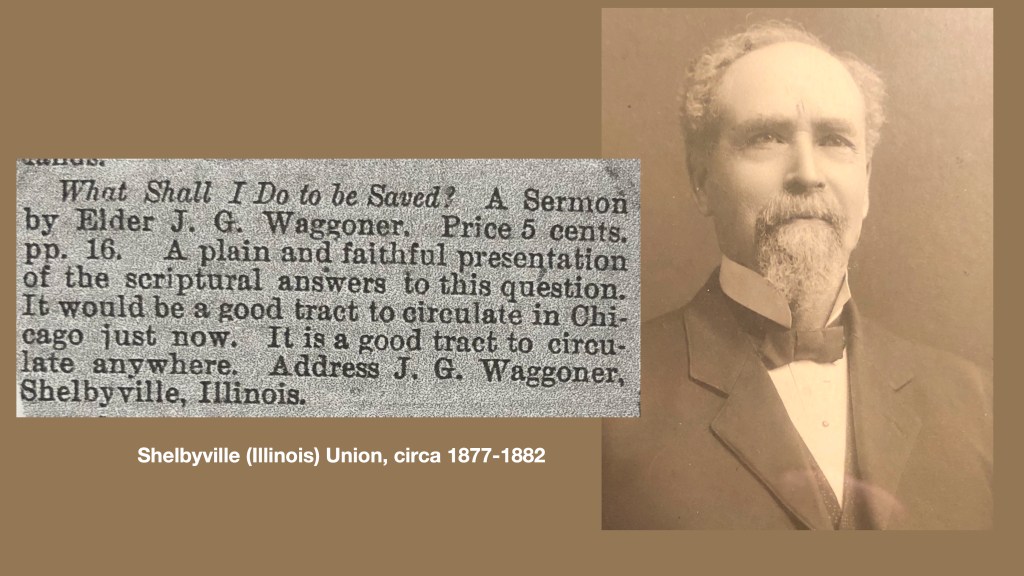
This week, though, salvation fell into my lap.  As some of you know, I am a fifth generation pastor.  My great-grandfather, Harvey Garland Waggoner, was the pastor at First Christian Church in Dixon, Illinois, during the Spanish Flu pandemic of 1918.  I have been seeking anything of his in the family archives from that time period so I could learn how to be a pastor in a pandemic.  No luck.  What I did find this week was this…

My great-great-grandfather John Garland Waggoner

“What Shall I Do to be Saved?  A Sermon by Elder J. G. Waggoner.  Price 5 cents.  pp. 16.  A plain and faithful presentation of the scriptural answers to this question.”  All of my work already done one hundred and forty years ago by my great-GREAT-grandfather, John Garland Waggoner.  And, at a very reasonable price in today’s dollars: 5 cents in 1880 is about $1.25 today in 2020.  Unfortunately, I don’t have a copy of that 16-page sermon.

(I love the sentence in the advertisement: “It would be a good tract to circulate in Chicago just now.”  Makes me one wonder what was happening in Chicago in 1880.  Probably not much different than today.  Would John Garland Waggoner write the same thing about The Windy City if he knew that his great-great-grandson would be born there eighty-five years later?)

Of course he would, because the next sentence, “It is a good tract to circulate anywhere,” indicates that he knows that sin is present anywhere…and all the time.

Which brings me around to today’s salvation topic: Saved From Sin.  The author of the Book of Hebrews writes, “Indeed, under the law almost everything is purified with blood, and without the shedding of blood there is no forgiveness of sins.”  Very true.  According to the Temple laws laid out in the Book of Leviticus every sin offering at the Temple in Jerusalem must be accompanied with a blood sacrifice.  That is how it worked…back then.

In the two songs in our service today, we sing the words found in those traditional Christian hymns, “washed in his blood” and “the old rugged cross, stained with blood so divine.”  Blood atonement.  Getting right with God, atoning for one’s sin, can only happen with blood.  The 20th-century pastor and theologian, Reinhold Neibuhr tells a wonderful story about blood atonement in his parish in Detroit.  “The old gentleman was there too who wanted to know whether I believed in the deity of Jesus.  He is in every town.  He seemed to be a nice sort, but he wanted to know how I could speak for an hour on the Christian church without once mentioning the atonement.  Nothing, said he, but the blood of Jesus would save America from its perils.  He made quite an impassioned speech.  At first I was going to answer him but it seemed too useless.  I finally told him I believed in blood atonement too, but since I hadn’t shed any of the blood of sacrifice which it demanded I felt unworthy to enlarge upon the idea.”

And I really feel the same way today as Neibuhr did one hundred years ago in 1920.  I am unworthy to enlarge upon the idea.  Speaking of large.  How about this idea of atonement?

“I want bigger virgins.”  Because if you offer yourself to the volcano, say your name is Joe Banks played by Tom Hanks in Joe Versus the Volcano, then, who knows, maybe your sins and the sins of the tribe will be absolved by the Volcano God. 

Maybe.  I do know this.  I am not one to throw myself into a volcano for the sake of absolution for the sins of the world.  Reinhold Neibuhr was/is correct.

I am not worthy to enlarge upon the idea of being “washed in the blood so divine.”  I AM grateful that the blood so divine flows through MY veins and arteries in this COVID pandemic-time.  Whereas the blood of 127,000 people and counting in our nation has ceased to flow – 51,000 of those deaths of people in nursing and retirement centers.  Two, Ed Alley and Jack Henneberry.  My mentors, teachers, coaches and friends.

They did not have to die from COVID-19.  And though I am unworthy to enlarge upon the idea of blood atonement, I will enlarge upon our understanding of sin for which blood atonement is made. 

Here is my sin.  Here is our sin.  Ed Alley and Jack Henneberry did not need to die from COVID-19. 

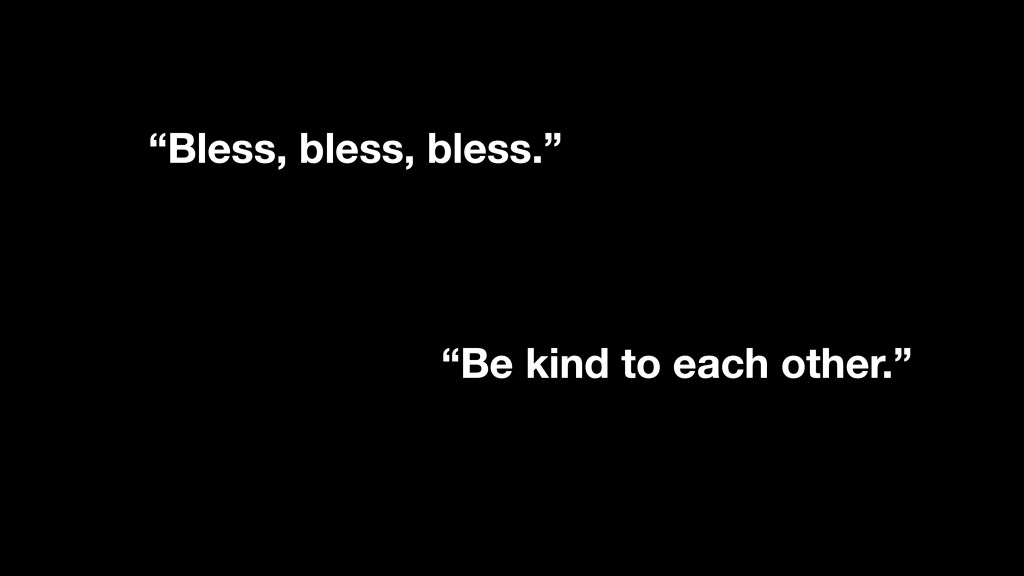
I was on a men’s retreat at Bedford Christian Camp in 1994 when I first met Ed Alley who was on staff for that weekend.  Big, tall man.  Bald.  Bearded with a joy-full face.  I asked him what his role on the weekend was.  Ed replied, “I am here to simply bless, bless, bless.”  As the principal for Western Avenue Elementary School, Jack Henneberry always ended the morning announcements with “Be kind to each other.”

Good advice.  Biblical advice.  Bless, bless, bless.  Love one another.  How to be saved from sin?  How to be saved from our separation from the God of Love?  Love one another.  Bless one another.  “Be kind to each other.”

“Moses took the blood of calves and goats, with water and scarlet wool and hyssop, and sprinkled both the scroll itself and all the people, saying, “This is the blood of the covenant that God has ordained for you.” – Hebrews 9:19-20

Holy Vampire,
who dies on a wooden stake
only to come back to life,
is there anything else
needing to be covered in blood?
Forty deaths in Atlanta?
Sixty-three in Chicago?
Imagine:
the blood of
one hundred and three
sprinkling the asphalt
over the weekend.
Do you have any new,
less bloody,
covenants
up Your sleeve?
Amen.

Salvation Story: Saved From Death

Even before Jesus was born, the ruler of the Roman Empire, Caesar, was called “Savior of the World.”  In the Greek and Roman understanding of salvation, salvation was about being saved from the perils of life by the gods or by a powerful benefactor, such as Caesar.  The Romans were not alone in thinking about salvation.  The Jews of the time had their own understandings of salvation.   In the First Testament there are numerous ideas about salvation each sharing in common the intervention of YHWH in some way or another.  One of my favorite meanings of the Hebrew word for salvation is “to make roomier” or to create more space.  [Heaven will never be crowded.]

When Paul writes what we call his first letter to the church in Thessalonika, he is, no doubt, mindful of the salvation-talk around him.  Most scholars believe that this letter is one of Paul’s earliest writings; perhaps reflecting Paul’s first way of talking about the salvation that Christ brings.  Paul is responding to a question that the Thessalonians have asked.  If we who are alive will be raised with Christ, what about those who are dead?  Here’s Paul’s response…

We each have our own understanding of salvation and that is why I like Paul’s later words, and I would say more mature words, to the church in Philippi, “work out your OWN salvation with fear and trembling.”

We hear in today’s scripture that Paul is working out what is for him his earliest understanding of salvation; God in Jesus Christ will save us from death.  Salvation from death was a big issue for some early Christians.  Death was all around them.  People hanging on crosses along roads as warnings to obey the Empire.  People dying from hunger and disease.  A horrifically high infant mortality rate.  Is it any wonder that Paul’s message appealed to many?  “Then we who are alive, who are left, will be caught up in the clouds together with them to meet the Lord in the air; and so we will be with the Lord forever.  Therefore encourage one another with these words.”  How encouraging do you really find these words? 

AND…Time passed.  Those who were left died.  Even Paul died.  So the understanding of being saved from death had to change.

“We are a resurrection people!”  We proclaim this as Christians.  It is at the heart of our religion.  And yet, as people of the resurrection, we tend to ignore the state of being that precedes resurrection: death.  We are quick to cry out, “New life!” while quickly passing over, “old death.”  The grim reaper, cloaked and hooded in black, carrying a scythe.  It’s been said, “In life, only two things are certain: taxes and death.”  In death, nothing is certain not even life; a Lazarus has yet to appear on Oprah telling about his exploits in the afterlife. 

Nothing is more terrifying for some people than death.  Death, more than any other condition or experience in life, pushes us into the very heart of things.  One moment there is life.  The next moment there is…nothing.  What do we make of this as human beings?  Is the end of our life the equivalent of an ant being stepped on; one moment crawling along, the next squished?  “Surely not!” we cry out.  Our very consciousness and awareness of “The End” must count for something.

The poet James Laughlin has a wonderful poem titled “The Junk Collector” that engages this very thought.   “What bothers me most about / the idea of having to die / (sooner or later) is that / the collection of junk I / have made in my head will / presumably be dispersed / not that there isn’t more / and better junk in other / heads & always will be but / I have become so fond of / my own head’s collection.”  Where will the collection of junk in our heads “go” when we die?  Most polls show that around 80% of Americans believe in an afterlife.  Somehow, some way, our junk remains with us even when we die.  Think about it: garage sales and flea markets in the afterlife.  Heaven for some.  Hell for others.

Today most Christians believe that salvation from death means that after we die we will live forever in God’s eternal realm.  Of course we must remember what my uncle said about such a state of heaven.  He declared, “If I have to listen to the heavenly host singing constantly, than I’d rather not go to heaven!”  Or, I have heard many folks say, “The alternative to Heaven just sounds more fun!”

I did a funeral for an elderly woman in Noblesville who everyone considered a saint in the church and in the community.  The first time I met her was when I offered to give her a ride to one of her many meetings.  She first scolded me for knocking on her front door when I should have come through the open garage door and walked right in.  I settled her in the front seat of my minivan and began our drive.  A pastor is always challenged in a call like this.  How best to begin a first conversation with a parishioner whom you do not know?  She saved me from another mishap by saying, “Eric, you’re probably the pastor that’s going to do my funeral.”  Okay.  “I have one request: do NOT say, ‘I have gone to a better place.’”  This profound and loving Christian did not believe in an afterlife.  She believed that in each and every moment of life we are SAVED FROM death in order to live into the line in the Lord’s Prayer that “God’s will may be done on earth” while we are alive.  And, oh, how she was alive!

Perhaps another turn to the poets is in order.

Antonio Machado – All things die and all things live forever; / but our task is to die, / to die making roads, / roads over the sea.

Yehuda Amichai – If now, in the middle of my life, I think / Of death, I do so out of confidence / That in the middle of death I will suddenly think / Of life, with the same calming nostalgia / And with the distant gaze of people / Who know their prophecies come true.

One of the reasons those early Jews, who would later call themselves Christians, thought that Jesus Christ would save them from death comes from their own story in scripture.  Jesus was seen as the Passover lamb.  PASSOVER!  The formative event of the people of Israel was used as a way to tell the story of Jesus.  Remember what Passover meant to them?   What happens when the angel of death passes over your door and death is once again kept at bay?  You LIVE!  You live for another day!