“Salvation Story: Saved From Sin”

The story of salvation continues…

I began planning for this sermon series before the COVID Pandemic.  My thinking was that “Salvation” would be a good topic to cover after our Lenten season of “Encountering Jesus.”  Well, the pandemic got in the way of those plans and delayed “Salvation” for a month or so.  And, I now had some more time to think about all the myriad ways one can think about salvation.  And like Pooh, I sat on my thinking log and went, “Think, think think.”  All of that thinking didn’t bring me any closer to salvation.

This week, though, salvation fell into my lap.  As some of you know, I am a fifth generation pastor.  My great-grandfather, Harvey Garland Waggoner, was the pastor at First Christian Church in Dixon, Illinois, during the Spanish Flu pandemic of 1918.  I have been seeking anything of his in the family archives from that time period so I could learn how to be a pastor in a pandemic.  No luck.  What I did find this week was this…
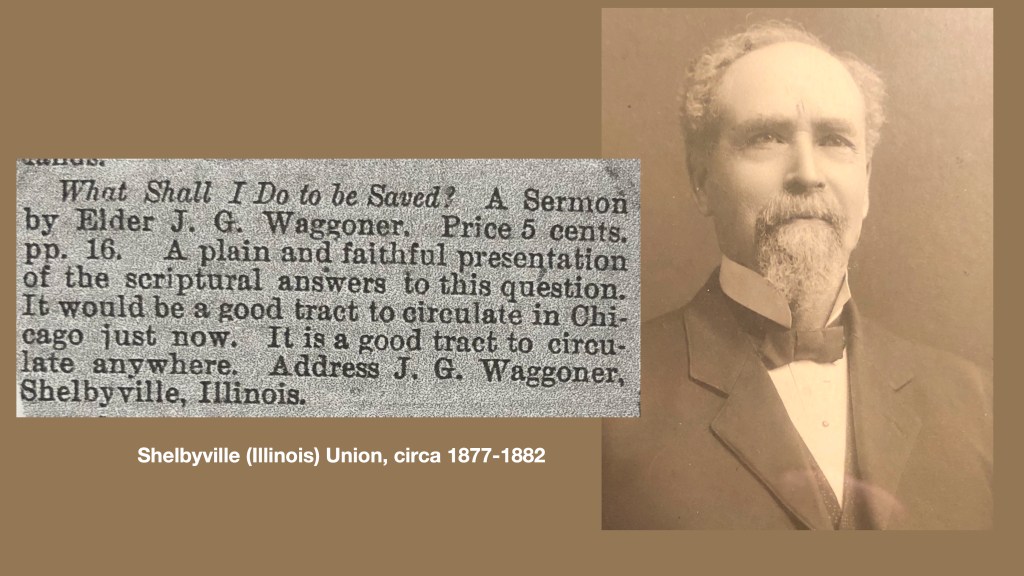
My great-great-grandfather John Garland Waggoner

“What Shall I Do to be Saved?  A Sermon by Elder J. G. Waggoner.  Price 5 cents.  pp. 16.  A plain and faithful presentation of the scriptural answers to this question.”  All of my work already done one hundred and forty years ago by my great-GREAT-grandfather, John Garland Waggoner.  And, at a very reasonable price in today’s dollars: 5 cents in 1880 is about $1.25 today in 2020.  Unfortunately, I don’t have a copy of that 16-page sermon.

(I love the sentence in the advertisement: “It would be a good tract to circulate in Chicago just now.”  Makes me one wonder what was happening in Chicago in 1880.  Probably not much different than today.  Would John Garland Waggoner write the same thing about The Windy City if he knew that his great-great-grandson would be born there eighty-five years later?)

Of course he would, because the next sentence, “It is a good tract to circulate anywhere,” indicates that he knows that sin is present anywhere…and all the time.

Which brings me around to today’s salvation topic: Saved From Sin.  The author of the Book of Hebrews writes, “Indeed, under the law almost everything is purified with blood, and without the shedding of blood there is no forgiveness of sins.”  Very true.  According to the Temple laws laid out in the Book of Leviticus every sin offering at the Temple in Jerusalem must be accompanied with a blood sacrifice.  That is how it worked…back then.

In the two songs in our service today, we sing the words found in those traditional Christian hymns, “washed in his blood” and “the old rugged cross, stained with blood so divine.”  Blood atonement.  Getting right with God, atoning for one’s sin, can only happen with blood.  The 20th-century pastor and theologian, Reinhold Neibuhr tells a wonderful story about blood atonement in his parish in Detroit.  “The old gentleman was there too who wanted to know whether I believed in the deity of Jesus.  He is in every town.  He seemed to be a nice sort, but he wanted to know how I could speak for an hour on the Christian church without once mentioning the atonement.  Nothing, said he, but the blood of Jesus would save America from its perils.  He made quite an impassioned speech.  At first I was going to answer him but it seemed too useless.  I finally told him I believed in blood atonement too, but since I hadn’t shed any of the blood of sacrifice which it demanded I felt unworthy to enlarge upon the idea.”

And I really feel the same way today as Neibuhr did one hundred years ago in 1920.  I am unworthy to enlarge upon the idea.  Speaking of large.  How about this idea of atonement?

“I want bigger virgins.”  Because if you offer yourself to the volcano, say your name is Joe Banks played by Tom Hanks in Joe Versus the Volcano, then, who knows, maybe your sins and the sins of the tribe will be absolved by the Volcano God. 

Maybe.  I do know this.  I am not one to throw myself into a volcano for the sake of absolution for the sins of the world.  Reinhold Neibuhr was/is correct.

I am not worthy to enlarge upon the idea of being “washed in the blood so divine.”  I AM grateful that the blood so divine flows through MY veins and arteries in this COVID pandemic-time.  Whereas the blood of 127,000 people and counting in our nation has ceased to flow – 51,000 of those deaths of people in nursing and retirement centers.  Two, Ed Alley and Jack Henneberry.  My mentors, teachers, coaches and friends.

They did not have to die from COVID-19.  And though I am unworthy to enlarge upon the idea of blood atonement, I will enlarge upon our understanding of sin for which blood atonement is made. 

Here is my sin.  Here is our sin.  Ed Alley and Jack Henneberry did not need to die from COVID-19. 

I was on a men’s retreat at Bedford Christian Camp in 1994 when I first met Ed Alley who was on staff for that weekend.  Big, tall man.  Bald.  Bearded with a joy-full face.  I asked him what his role on the weekend was.  Ed replied, “I am here to simply bless, bless, bless.”  As the principal for Western Avenue Elementary School, Jack Henneberry always ended the morning announcements with “Be kind to each other.”

Good advice.  Biblical advice.  Bless, bless, bless.  Love one another.  How to be saved from sin?  How to be saved from our separation from the God of Love?  Love one another.  Bless one another.  “Be kind to each other.”
“Moses took the blood of calves and goats, with water and scarlet wool and hyssop, and sprinkled both the scroll itself and all the people, saying, “This is the blood of the covenant that God has ordained for you.” – Hebrews 9:19-20

Holy Vampire,
who dies on a wooden stake
only to come back to life,
is there anything else
needing to be covered in blood?
Forty deaths in Atlanta?
Sixty-three in Chicago?
Imagine:
the blood of
one hundred and three
sprinkling the asphalt
over the weekend.
Do you have any new,
less bloody,
covenants
up Your sleeve?
Amen.

Salvation Story: Saved From Death

Even before Jesus was born, the ruler of the Roman Empire, Caesar, was called “Savior of the World.”  In the Greek and Roman understanding of salvation, salvation was about being saved from the perils of life by the gods or by a powerful benefactor, such as Caesar.  The Romans were not alone in thinking about salvation.  The Jews of the time had their own understandings of salvation.   In the First Testament there are numerous ideas about salvation each sharing in common the intervention of YHWH in some way or another.  One of my favorite meanings of the Hebrew word for salvation is “to make roomier” or to create more space.  [Heaven will never be crowded.]

When Paul writes what we call his first letter to the church in Thessalonika, he is, no doubt, mindful of the salvation-talk around him.  Most scholars believe that this letter is one of Paul’s earliest writings; perhaps reflecting Paul’s first way of talking about the salvation that Christ brings.  Paul is responding to a question that the Thessalonians have asked.  If we who are alive will be raised with Christ, what about those who are dead?  Here’s Paul’s response…

We each have our own understanding of salvation and that is why I like Paul’s later words, and I would say more mature words, to the church in Philippi, “work out your OWN salvation with fear and trembling.”

We hear in today’s scripture that Paul is working out what is for him his earliest understanding of salvation; God in Jesus Christ will save us from death.  Salvation from death was a big issue for some early Christians.  Death was all around them.  People hanging on crosses along roads as warnings to obey the Empire.  People dying from hunger and disease.  A horrifically high infant mortality rate.  Is it any wonder that Paul’s message appealed to many?  “Then we who are alive, who are left, will be caught up in the clouds together with them to meet the Lord in the air; and so we will be with the Lord forever.  Therefore encourage one another with these words.”  How encouraging do you really find these words? 

AND…Time passed.  Those who were left died.  Even Paul died.  So the understanding of being saved from death had to change.

“We are a resurrection people!”  We proclaim this as Christians.  It is at the heart of our religion.  And yet, as people of the resurrection, we tend to ignore the state of being that precedes resurrection: death.  We are quick to cry out, “New life!” while quickly passing over, “old death.”  The grim reaper, cloaked and hooded in black, carrying a scythe.  It’s been said, “In life, only two things are certain: taxes and death.”  In death, nothing is certain not even life; a Lazarus has yet to appear on Oprah telling about his exploits in the afterlife. 

Nothing is more terrifying for some people than death.  Death, more than any other condition or experience in life, pushes us into the very heart of things.  One moment there is life.  The next moment there is…nothing.  What do we make of this as human beings?  Is the end of our life the equivalent of an ant being stepped on; one moment crawling along, the next squished?  “Surely not!” we cry out.  Our very consciousness and awareness of “The End” must count for something.

The poet James Laughlin has a wonderful poem titled “The Junk Collector” that engages this very thought.   “What bothers me most about / the idea of having to die / (sooner or later) is that / the collection of junk I / have made in my head will / presumably be dispersed / not that there isn’t more / and better junk in other / heads & always will be but / I have become so fond of / my own head’s collection.”  Where will the collection of junk in our heads “go” when we die?  Most polls show that around 80% of Americans believe in an afterlife.  Somehow, some way, our junk remains with us even when we die.  Think about it: garage sales and flea markets in the afterlife.  Heaven for some.  Hell for others.

Today most Christians believe that salvation from death means that after we die we will live forever in God’s eternal realm.  Of course we must remember what my uncle said about such a state of heaven.  He declared, “If I have to listen to the heavenly host singing constantly, than I’d rather not go to heaven!”  Or, I have heard many folks say, “The alternative to Heaven just sounds more fun!”

I did a funeral for an elderly woman in Noblesville who everyone considered a saint in the church and in the community.  The first time I met her was when I offered to give her a ride to one of her many meetings.  She first scolded me for knocking on her front door when I should have come through the open garage door and walked right in.  I settled her in the front seat of my minivan and began our drive.  A pastor is always challenged in a call like this.  How best to begin a first conversation with a parishioner whom you do not know?  She saved me from another mishap by saying, “Eric, you’re probably the pastor that’s going to do my funeral.”  Okay.  “I have one request: do NOT say, ‘I have gone to a better place.’”  This profound and loving Christian did not believe in an afterlife.  She believed that in each and every moment of life we are SAVED FROM death in order to live into the line in the Lord’s Prayer that “God’s will may be done on earth” while we are alive.  And, oh, how she was alive!

Perhaps another turn to the poets is in order.

Antonio Machado – All things die and all things live forever; / but our task is to die, / to die making roads, / roads over the sea.

Yehuda Amichai – If now, in the middle of my life, I think / Of death, I do so out of confidence / That in the middle of death I will suddenly think / Of life, with the same calming nostalgia / And with the distant gaze of people / Who know their prophecies come true.

One of the reasons those early Jews, who would later call themselves Christians, thought that Jesus Christ would save them from death comes from their own story in scripture.  Jesus was seen as the Passover lamb.  PASSOVER!  The formative event of the people of Israel was used as a way to tell the story of Jesus.  Remember what Passover meant to them?   What happens when the angel of death passes over your door and death is once again kept at bay?  You LIVE!  You live for another day!

“Then we who are alive, who are left, will be caught up in the clouds together with them to meet the Lord in the air; and so we will be with the Lord forever.” 1 Thessalonians 4:17

God who comes and
Toots His Own Holy Horn,
where angels call
and the faces of earth's multitude turn Heavenward
with the crossed-fingered, hope of rising first,
with those desirous,
and who hold the ticket of their small faith,
of taking a trip on a cloud like a Disney ride,
to the Lord's Forever-Ever-Land,
...Bah! And boo, boo, boo!
You know the Plan.
No one goes until everybody goes.
The notion of The Elect, Your Holy Elect,
kills the least of these
over and over and over
again and again and again.
Speak plainly.
Mean the words of the mountaintop.
Stay with us.
Amen.

“Now a new king arose over Egypt, who did not know Joseph.  He said to his people, Look, the Israelite people are more numerous and more powerful than we.” – Exodus 1:8-9

God, clother of Adam & Eve
God, designer of the mark written on Cain
God, gifter of the rainbow
God, appointer of Abraham
God, stayer of the hand of the slayer of son Isaac
God, chooser of Joseph,
God, creator of kings,
how can a newly created king not know of Joseph?
Shouldn't the lack of knowledge
turn people into blathering idiots
who only know how to follow and how to be slaves?
Why do idiocy and stupidity seem to always take
the thrones of condemnation and carelessness?
Do you, God, get some perverse pleasure
out of the rare instances where
powerlessness prevails over power?
Sure, the names of the powerlessness
ring across the history of humanity
but the names of those wiped away
with the wave of a hand by those in power
are more numerous
than grains of sand on Crescent Beach
and more numerous
than the countless stars in the universe
and, horrifically, forgotten.
God of upside down power and God of upended numbers,
the multitudes cry out, Save us!
Amen.