There’s no place like…

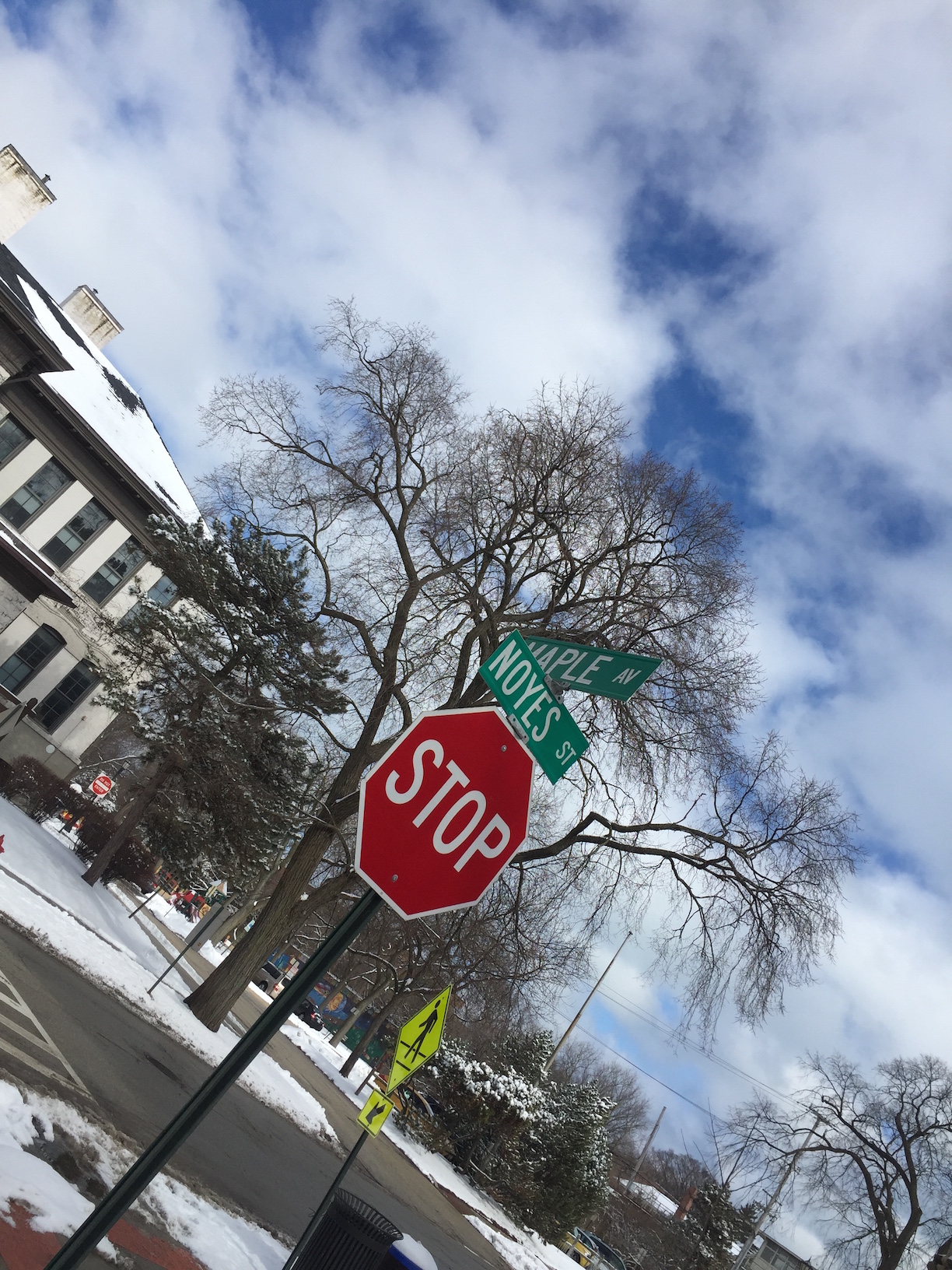
Maple Avenue and Noyes Street, Evanston, Illinois (February 2019)

Fifty-four years old. Fifty-four years of being one of the lucky ones to call a particular address “Home.” Fifty-four years of memory…

I was born at 2560 Ridge Avenue in an Evanston Hospital delivery room. I have been told there was a snow event that day. A few days later I took my first car ride south down Ridge Avenue to an apartment building at the corner of Maple Avenue and Noyes Street – right next to the Noyes Station on Chicago’s ‘L’ (Elevated) Purple Line. I don’t remember my first home nor do I remember the sound of the L right outside my bedroom. Development psychologists would say that the sounds reverberating through my first home as L cars went by shaped my sense of wonder and the peace that I feel when I hear a train. (Just this past weekend I waited for sleep lying in my boyhood bed while visiting my brother and heard the sounds of a train whistle and the roll of its wheels in the distance. I fell immediately to sleep.)

A year later I moved (or, rather, was moved by my parents) to my next home on Michigan Avenue on the border of Evanston and Chicago. My first memory comes from my time at this apartment building. It is a very strong memory, probably because it involves four of my five senses: sight, sound, touch and smell. I sat on the stairs between two floors of the apartment building just high enough where I could see through the transom window over the front door of the apartment below. Out of the transom window came light from within, the sounds of a party (laughter and conversation), the smells of cooking (chicken?) while my butt was keenly aware that it was on the hard wood of the steps. I felt intense sadness at being outside while the party went on inside. I felt excluded and uninvited. The laughter that came out the transom seemed directed at me. I remember standing, placing a hand on the wooden railing as I turned to walk up the stairs. End of memory.

Just as trains bring me peace I have no doubt that my dis-ease and discomfort with parties starts with this memory. I am also aware that my strong sense of justice (and injustice), particularly when it comes to inclusion and exclusion, begins on those steps. Is it possible for a two-year-old to form at that early stage of being human a life’s call to purpose and mission where no human being should feel what I felt on those hard steps?

More home addresses followed. Buffalo Grove. Back to Evanston. Arthur, Illinois. Topeka, Kansas. Flossmoor, Illinois. Greencastle, Indiana. Logan Square, Chicago. Indianapolis. Martinsville, Indiana. Irvington, Indiana. Kalamazoo. Back to Irvington. Noblesville, Indiana.

So many memories. Beginning at home on Maple Avenue in Evanston. Continuing at my current home on Maple Avenue in Noblesville. More, I am sure, to come…
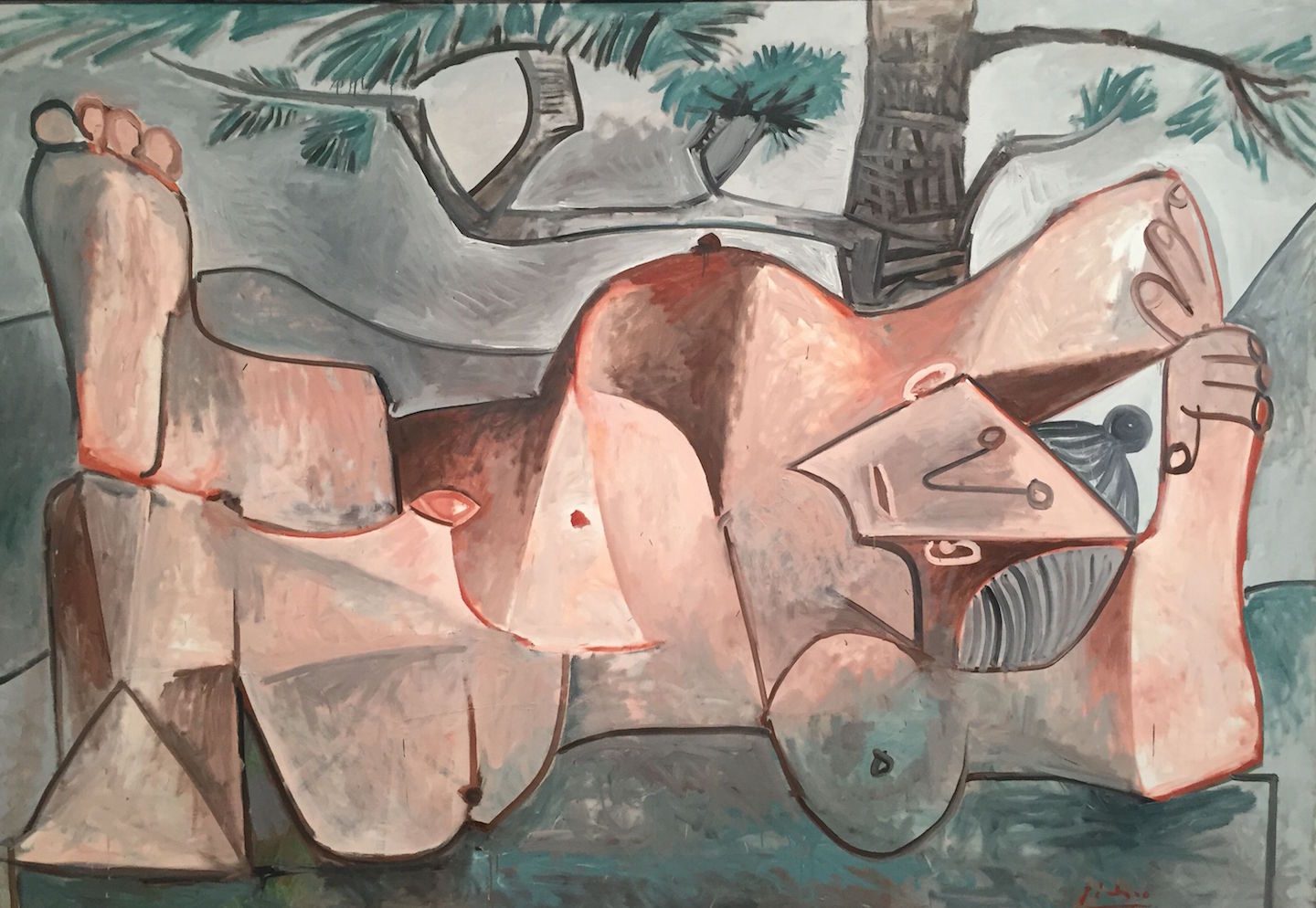

In the Eye of the Beholder…

Nude Under a Pine Tree, Pablo Picasso

“Many things that come into the world are not looked into. The individual says, ‘My crowd doesn’t run that way.’ I say, don’t run with crowds.”
― Robert Henri, The Art Spirit

I have stood before Rembrandt’s “The Night Watch” at the Rijksmuseum in Amsterdam mesmerized by the immensity of the painting (12’ by 14’) and by the striding almost life-sized figures in black and white.

I have stood in front of Rembrandt’s “The Return of the Prodigal Son” at the Hermitage Museum in St. Petersburg not knowing what an impact it would have on my spirituality at seminary four decades later.

I contemplated Leonardo da Vinci’s “Mona Lisa” at the Louvre Museum wondering why this was such a famous painting.

I have stood before da Vinci’s “The Last Supper” at the Santa Maria delle Grazie in Milan imagining for myself what Jesus’ last meal with his disciples might have looked like.

Twice I have stood below Michelangelo’s ceiling paintings at the Sistine Chapel in the Vatican City looking upward trying to imagine how Charlton Heston created such a wonder – in agony and in ecstasy.

In the late-1980’s when I was a banker in downtown Chicago I would take advantage of admission-free Thursdays at The Art Institute of Chicago and pay a lunchtime visit. I could walk out the front entrance to my place of work at the corner of Adams Street and Wacker Drive, pick up a toasted everything bagel with cream cheese along the eight-block walk down Adams and enter straight into the front entrance of the AIC. As my lunch hour was limited to sixty-ish minutes I did not have the luxury to take on the museum stroll for very long. Thankfully my favorite room was the room at the top of the first flight of stairs after coming in the front doors off of Michigan Avenue between the famous lions.

Yesterday, twenty-nine years after my last visit, I made that same entrance and climbed the same first flight of stairs delighted that my Impressionists were still located in the very same room.

My tastes have changed. Whereas on my Thursday lunchtime visits I could sit and easily pass the time noting the differences in palette between Monet’s Haystacks, yesterday I was moved by Chagall, Dove and Picasso, and was fairly indifferent to the work of my beloved Cezanne.

There is so much beauty in the world; not just in the world of art. It is humanly impossible, for this human in particular, to see ALL as beautiful all the time. And yet, Picasso’s Nude Under a Pine Tree is not an object of beauty until I turn a corner and go, “Wow!”

“Beauty is no material thing. Beauty cannot be copied. Beauty is the sensation of pleasure on the mind of the seer. No thing is beautiful. But all things await the sensitive and imaginative mind that may be aroused to pleasurable emotion at the sight of them. This is beauty.”
― Robert Henri, The Art Spirit

The Cost of Convenience…

Shipping Labels

Yesterday I received four padded mailers from Amazon. Each contained one or more small booklets that I had ordered two days prior – yes, I am a Prime Member. Each mailer was identical in size. Two plastic mailers. Two manila mailers. One mailer came from Philadelphia. One from Kansas City. One from Columbus. One from Kenosha. All were sent to the Amazon sort center in Hebron (Kentucky) which directed them to the Noblesville Postal Service for delivery to my home.

I work for Amazon. Each day I have occasion to think, “How in the world does my company make any money?” I see inefficiencies everywhere. I believe this question is endemic to all persons in all workplaces, i.e. I am not alone in sighing at my perceived sense of waste of dollars and human effort. When I return from work where I raised that question and find FOUR mailers for ONE order on my front porch, I sigh and raise the same question again: How is it possible for any person or non-person to make any money with such apparent waste?

I have an undergraduate degree where I majored in Economics and one quarter of a Masters of Business Administration in Economics. I “learned” that markets, processes, human endeavors, human consumption and human delights, if left unattended, unregulated, untaxed, unpersuaded and uncontrolled (whatever that may mean) in any manner would seek an equilibrium point of interaction that would be the most “efficient” point for that particular transaction or endeavor. (I recognize that this is a gross oversimplification of very complex and many-layered ventures and undertakings.)

In the Good Old Days of Yore I would have shopped for the same items at my local Barnes & Noble in Noblesville. One shopper – me. One store. All eight items located in the same shelf. I would have paid the listed price printed on the ISBN label less the discount for being a Barnes & Noble Loyal Customer. I would bring those items home and happily consume them in the way in which each was created to be consumed.

Fast forward to today. I paid the same list price for the items on the ISBN at Amazon – sorry, no price reduction. I received my employee discount which is roughly equivalent to a Loyal Customer discount. My shipping was as free as if I had brought the items home from Barnes & Noble of Noblesville myself – again, I am a Prime Member.

Net out-of-pocketbook dollar cost to me, Mr. Consumer, is the same for both transactions.

So, here’s the rub: How is it that Amazon.com flirts with being the World’s Most Valuable Company in this scenario?

Surely, it can’t be because of any efficiency gains created by the United States’ sole God, the God of the Free Market, and His Son, Economies of Scale and Efficient Equilibrium Who is constantly being crucified by Socialists, Market Manipulators and Taxes? Any sane Priest of Economics would say that this is exactly what is happening and defend Jeff Bezos’ right, indeed any person’s right, to interact with the Noble Consumer who is pushed around and/or pulled by the Invisible Hand of the God – or Goddess – of Whimsy.

I, once a Priest of Economics, a Follower of Friedman, a Dilettante of Dodd and Debreau and a Student of Stigler (yes, I was George Stigler’s caddy every Tuesday morning at Flossmoor Country Club during the summers of my youth), am now – and, to be honest, have been for some time – skeptical of the Holy Scripture of Economic Efficiency.

I am now declaring myself a Conservative in that I rejoice in and believe to be true that the sole measure of efficiency, any sort of efficiency, is that which gives me the most output of goods and services provided by others for as little input as possible of my own time and Being and personal resources i.e. conserves my time, my self, and my money.

I am now…conveniently…a Conservative of Convenience…my convenience.

panem et circenses

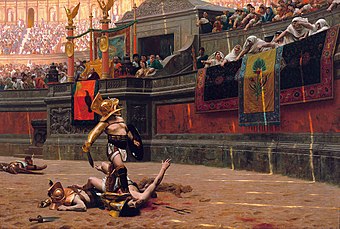
Pollice Verso by Jean-Léon Gérôme

My first Super Bowl memory comes from January 18, 1976. My beloved Dallas Cowboys led by my boyhood hero, Roger Staubach, were playing in Super Bowl X against the hated Pittsburgh Steelers. I watched the game in a Holiday Inn guest room in Harvey, Illinois. (The family had just moved from Topeka, Kansas to Flossmoor, Illinois. We were staying at the Holiday Inn while renovations were being completed on the parsonage that was to become my “boyhood” home.) It was a close game. Lynn Swann was named MVP; making catches that became part of his career highlight video. Roger made a Hail Mary with three seconds to go that was intercepted in the endzone. Steelers 21. Cowboys 17. And my heart broke.

Two years later, January 15, 1978, in the first Super Bowl played in a dome (Super Bowl XII), my Cowboys rode those Broncos to victory. Cowboys 27. Broncos 10.

January 21, 1979. The year of the Mean Joe Greene ad where Mean Joe turns nice after being handed a Coke by a young fan. The game was another heartbreaker. Super Bowl XIII (unlucky 13). Steelers 35. Cowboys 31. And the Cowboys were never heard from again after the Staubach era ended until another quarterback, Troy Aikman, brought them to the big game fourteen years later.

After 1979 all my attention turned to my hometown team. The Monsters of the Midway. The Chicago Bears.

The date January 26, 1986 in Super Bowl lore could be seen in many lights. Super Bowl XX was the very first appearance in a Super Bowl by the New England Patriots. The first of eleven. It was also the first appearance by the Chicago Bears. The final score was the largest margin of victory in a Super Bowl. Bears 46. Patriots 10. The Fridge took the plunge. Sweetness did not score. The Bears shuffled home, champions.

The most memorable moment of that game came from the pre-game show where Tom Brokaw interviewed President Ronald Reagan. Near the end of the interview Reagan asked Brokaw for a moment of privilege in order to share a football memory of his playing days at Eureka College. The memory Reagan shared was a story that involved himself and his good friend and teammate, Bud Cole, my great uncle. (Catch the story at 6:45.) I still remember how delightfully shocked the family was watching the telecast in the warmth of Siesta Key, Florida.

My interest in the big game has lessened such that I find the use of Roman numerals as a way of numbering the Super Bowls more interesting than any of the actual games. Much has been written about how America’s zeal for the big game mirrors the zeal of the Roman Empire for it’s games. Americans are happy – and easily distracted from what really matters in life – as long as they are served bread and games. I believe there is some truth to the comparison. However, there is A TRUTH when it comes to the Super Bowl…Americans are happiest when the New England Patriots lose.

Grief Described…

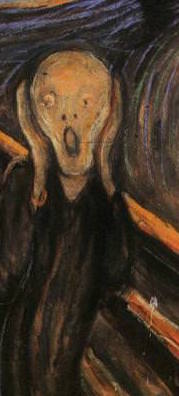
from “The Scream” by Edvard Munch

…or the most difficult thread to follow…

(For those who encounter this Blog and/or this post for the first time… My daughter, Sydney Marie Brotheridge, committed suicide and died on June 9, 2018.)

Warning: Grammar Ahead!

(How many times have I said or have heard the following said: “Grammar kills me!” or “If I have to conjugate one more verb I’m going to kill myself!” Needless to say, I have a deeper and more profound understanding of the significance of Grammar’s Death-Dealing Ways when placed alongside Life’s Death-Dealing Ways.)

So, in the immortal words of my high school freshman Language Arts teacher, Mr. Chip Shields: “Grammar is important. Proper grammar could save your life.” (I have no idea if Mr. Shields said those EXACT words back in 1979 but they capture the gist of what I took away from those tedious Grammar units in Language Arts.)

Two dictionary definitions: Grief as a noun and Grieve as a verb in two forms…

Grief, noun, Intense sorrow, especially caused by someone’s death

“I am overcome with Grief because of Sydney Marie’s death.”

Grieve, verb, [intransitive] to feel very sad, especially because someone has died

“I am still grieving the death of my daughter, Sydney Marie.”

Grieve, verb, [transitive] to make you feel very sad

“Sydney Marie’s death grieves me that I could do nothing to help her.”

I love how the Oxford Dictionary winnows incredibly complex thoughts, processes, states of being and human emotions down to a few simple words. (An aside: It strikes me that the Dictionary Method is the exact opposite of the Poetic Method. In other words, the Poetic Method takes a few simple words to create in the reader’s mind complex thoughts, processes, states of being and human emotions. I can’t help but feel that the difference is similar to a preference between: “Who’s on First?” by Abbott and Costello or “Chapter V: Advice From A Caterpillar” from Alice’s Adventures in Wonderland by Lewis Carroll?)

Google “grief” and you can click pages and pages and pages of “Next,” which leads me to think that Oxford’s dictionary definition cannot fulfill what a person wants when s/he seeks to live with grief. (Another aside: I think a fairly strong case can be made that Grief is more complex than Love when it comes to lived human experience. OR, and this is a novel thought for me, perhaps Grief, not Hate, is the opposite of Love. I am going to have to explore that thread a bit more…later.)

…Back to my Grief over Sydney Marie’s death which grieves me when I am grieving.

I have not found solace or solution for MY Grief in the countless books about Grief. The number of websites, let alone books, that number Grief in one way or another numbs my mind…and my heart. For example: “6 Grief Books That Actually Helped,” “9 Best Books for Dealing With Grief and Loss,” “32 Books About Death and Grief,” “11 Books to Help You Confront Your Grief” (How insane is the idea “confront your Grief”?), “Journeying Through Grief” (As if Grief is a location or an adventure), and my favorite, “I’m Dying Up Here: Books on How to Grieve and How to Die.”

Instead, give me a poem. Give me a poem.

Here are two books of poetry that currently carry me along my almost impossible and certainly insane “Journey through the Adventure-Land of Grief”:

The Art of Losing: Poems of Grief & Healing edited by Kevin Young

Holocaust Poetry compiled and introduced by Hilda Schiff

AND, more than any other, THE ONE POEM that captures the nature of MY GRIEF (One thing I have learned about Grief is that Grief is VERY personal and VERY different for each individual) is the following:

TAKE MY GRIEF… by Charla Norman
Do you want my grief,
Take it please,
Hold it next to your heart,
Feel it burn and tear you apart,
Please I beg of you,
Ease my mind,
Give me sleep for just one night,
Get the flashbacks,
The heart stopping pangs,
The helplessness from losing my way,
Can you feel my grief,
Hold it close,
It will bring you to your knees,
Your soul will yell, it will scream,
Can you hear it bellow while it takes your peace,
Your body aches, your mind stands still,
You live in the past, where things were real,
Help me friend,
I ask of you,
Take this grief,
For a day or two,
Just long enough, so I can clear my head,
So I can pretend my child’s not dead.


On Clotho, On Lachesis, On Atropos…NOT!

by Georgia Moore

First, this is not a “Sewing” web log or “blog” for short.

There will be no thoughts on running stitches. Nothing about basting stitches. Not a word on the backstitch; though I like the connotations of the word “backstitch.” No catch stitching clarifications. Likewise, no slip stitching; again, interesting undertones. No buttonhole stitching. And, from what my limited knowledge and Googling has shown me, these types of stitches are just names for hand-sewn stitches. There are other categories of stitches. So, let me make a blanket statement about sewing machine stitches: none will be found.

The extent of my sewing knowledge and of my sewing ability is limited to crudely bringing together with needle and thread two sides of cloth of a favorite item of clothing which has been ripped or torn; usually a shirt or the crotch of a pair of shorts or pants. Sometimes the color of the thread that I use matches the cloth I am sewing together. Sometimes.

No, I am not interested in the physical use of thread and the act of sewing. Reader, if this is your primary interest then click on another link in your search for thread-related websites.

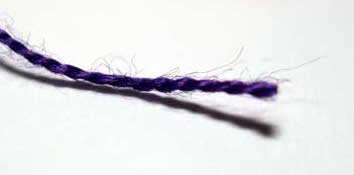
I am, however, very interested in thread as metaphor, as a concept, as a thought-experiment, as a symbol and as a way of understanding what pulls me through Life.

The title of this blog comes from the first line of the poem “The Way It Is” by William Stafford.

“There is a thread you follow.”

“The Way It Is” is one of my favorite poems. William Stafford is one of my favorite poets. Yes, there will be poems in this blog. Many poems.

Note: I do NOT want to give the impression that this is a blog devoted to a deterministic understanding of the human condition; as if the Greek fates, Clotho, Lachesis and Atropos, were sitting on their stools creating the thread of an individual’s life, dispensing that thread of life and then ending a thread of life with a quick snip of a pair of mythic scissors. Imagine how busy they would be given the billions and billions of lives that have been, that are and that will be. Busy, busy, busy. Though I do like the discovery made by the Ancient Greeks about the effectiveness of the division of labor.

A side note: If you are interested in gorgeous art, Google images of “Greek Fates”.

Simply put: the guiding theme of this blog is to follow the multiple and various and infinite threads of Life as I live them…

Read on if this seems appealing.

Feel free to leave a comment if the thread you follow is pulled in any particular way by my reflections on the thread that I follow.

And enjoy.

There’s a thread you follow…

The Way It Is

by William Stafford

There’s a thread you follow. It goes among
things that change. But it doesn’t change.
People wonder about what you are pursuing.
You have to explain about the thread.
But it is hard for others to see.
While you hold it you can’t get lost.
Tragedies happen; people get hurt
or die; and you suffer and get old.
Nothing you do can stop time’s unfolding.
You don’t ever let go of the thread.

From The Way It Is: New & Selected Poems, Graywolf Press, (1998).