Table of Contents – What A Mess!

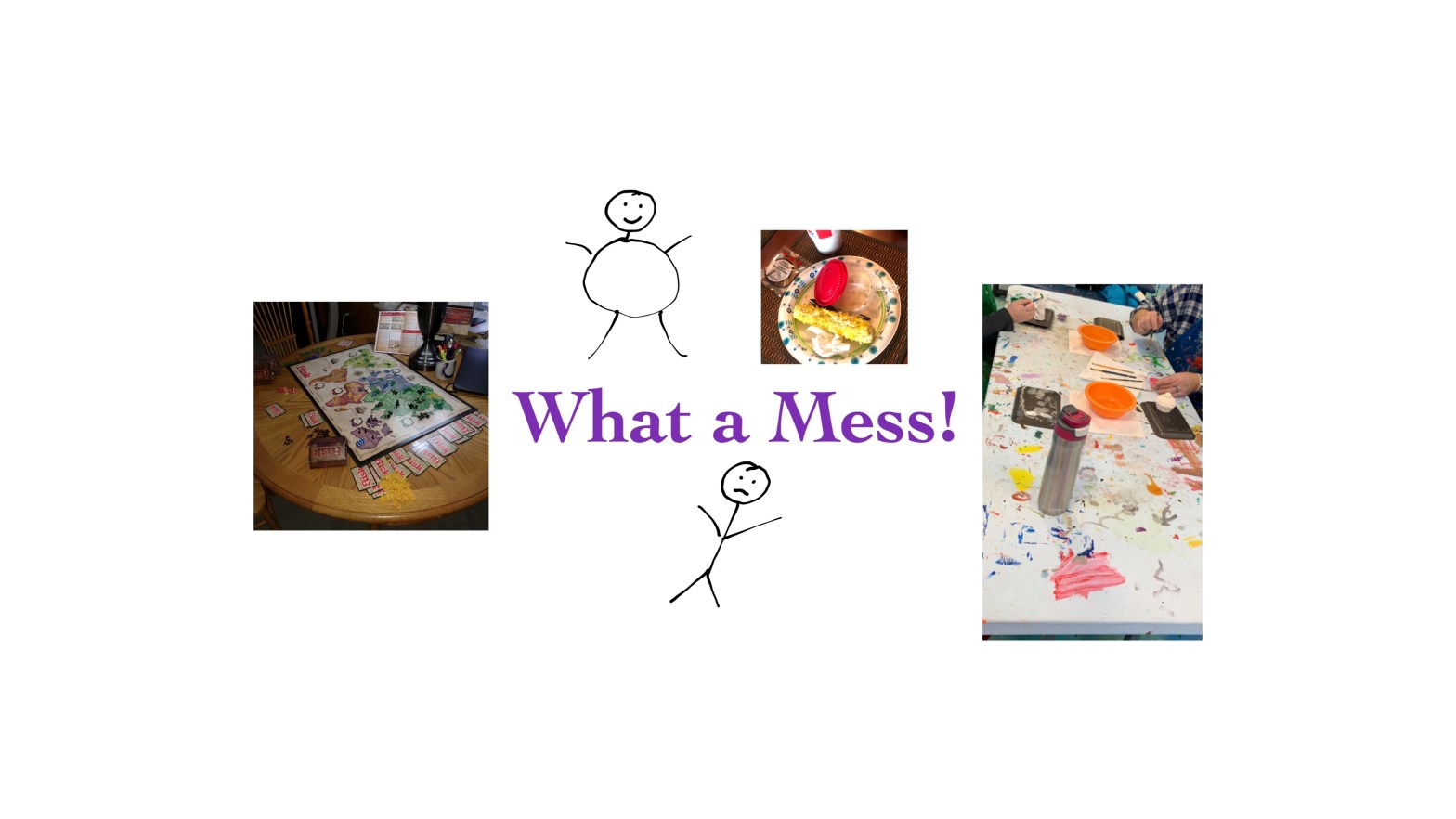
What a mess! How many of you have heard Paul’s description of the words at the Lord’s Table in their context before? Words said millions and millions of times over the bread and the cup over the last two thousand years: “‘This is my body that is for you. Do this in remembrance of me.’ In  the same way he took the cup also, after supper, saying, ‘This cup is the new covenant in my blood. Do this, as often as you drink it, in  remembrance of me.’” Add in Paul’s words to the Corinthians before these instructions and you get a biblical equivalent of John Belushi standing up in scripture and yelling, “Food fight!” And, not to be outdone, after the words of institution, your worst nightmare-ish vision of demon-Mom sending you off to bed with no supper for fighting with your brother.

All of this reminds me of a food fight my brother and I had in the kitchen of the house in which we grew up. The parents went out for dinner leaving two junior high-aged sons home alone and food on the table for OUR dinner. (Thanks, Mom! You’re the best!) I have no idea what the main course was but I do remember cherry jello with mandarin slices and chocolate pudding. I thought my brother and I did a fantastic job of what Paul asks of us, Examine yourselves. We did. We examined ourselves and the kitchen for spots of food. We rinsed our clothes. Mopped the floor. Wiped off cabinets and counters and the ceiling. Only to be called downstairs upon our parents return and to be asked by Mom, Why is there a mandarin orange slice in the kitchen curtain? Why is there a mandarin orange slice in the kitchen curtain? I thought about pointing at my brother. I am sure he was thinking about pointing at his brother. We took the question, Am I my brother’s keeper very seriously. Uhm, well, levitation? I mean, Keith – my brother – I think dropped an orange slice and it landed on the end of a spoon handle and, well, then my elbow accidentally came down on the spoon which then allowed the mandarin orange slice to defy gravity and fly ten feet across the kitchen to land in the fold of the curtain. I look at my brother for confirmation and I get a nod. The next morning I came down for breakfast and Mom was scraping out some dried chocolate pudding from the window frame molding.

My point, though, in sharing this story is this: If Mom has the power to pick out a mandarin orange slice in the rear fold of a curtain five feet above her line of sight – I exaggerate for effect – then how much more can God discern our hearts when we come to the table? And, I don’t think God is too concerned about mandarin orange slices in kitchen curtains or chocolate pudding in window molding as much as God is concerned about OUR concern for the Body of Christ.

Paul is on a terror in these lines of scripture: Now in the following instructions I do not commend you, because when you come together it is not for the better but for the worse. For all who eat and drink without discerning the body, eat and drink judgment against themselves. For this reason many of you are weak and ill, and some have died. Now there are many scholars who will take Paul’s little diatribe at face value and say that some wealthy people who were hungry couldn’t wait for the buffet that always accompanied the Lord’s Table celebration back then to start so they ate and got drunk before everyone else arrived, particularly before the poor and hungry folks who would like some food and drink as well. It’s like coming to one of our birthday dinners on time and yet all the food and drink is gone – including all of the pink, red and white M & M’s in the dishes at the table for February birthdays – and the rest of those gathered are having a grand time; full and content.

But Paul is NOT raging against some folks who decided to eat before the dinner bell rang. The earliest memory that I have – and I think I have shared this story with you all before – is sitting on the stairs of my apartment building where we lived when I was two or three. I am sitting about halfway up the stairs, looking at the open transom window above the door of my best friend’s apartment. There are smells of cooking and shouts of celebration as a birthday party for my friend is being held. And I am excluded, shut out, and alone. (Now, that’s what I remember. I was probably at his birthday party that he had for friends and neighborhood kids.)

It is the sting, the ache, the tears of exclusion, being shut out, and of being alone that are remembered. Remember me, asks Jesus. Paul passes along Jesus’ words: Do this in remembrance of me. The early 20th-century, Russian, Christian philosopher, Nikolai Berdyaev wrote, “The question of bread for myself is a material question, but the question of bread for my neighbor is a spiritual question.” This bread, my body broken for you, says Jesus. The next time you break bread think about the mess WE are all in together. And the next time you hear the words, My body broken for you, remember who the you…are. Examine yourselves, and only then eat of the bread and drink of the cup.  For all who eat and drink without discerning the body, eat and drink judgment against themselves. What a mess! Imagine, the act of re-membering as an act of cleaning up after a food fight.
Examine yourselves… 1 Corinthians 11:28

Holy Questioner and Divine Judge,
you allowed yourself to be stretched out
upon the Roman cross.
May this bread and this cup
stretch our minds
beyond
the hurt we wish to inflict,
so divisions that make us hungry to hurt
and thirst for our righteousness to be done
come together at a table.
Amen.

Table of Contents – What a Feast!

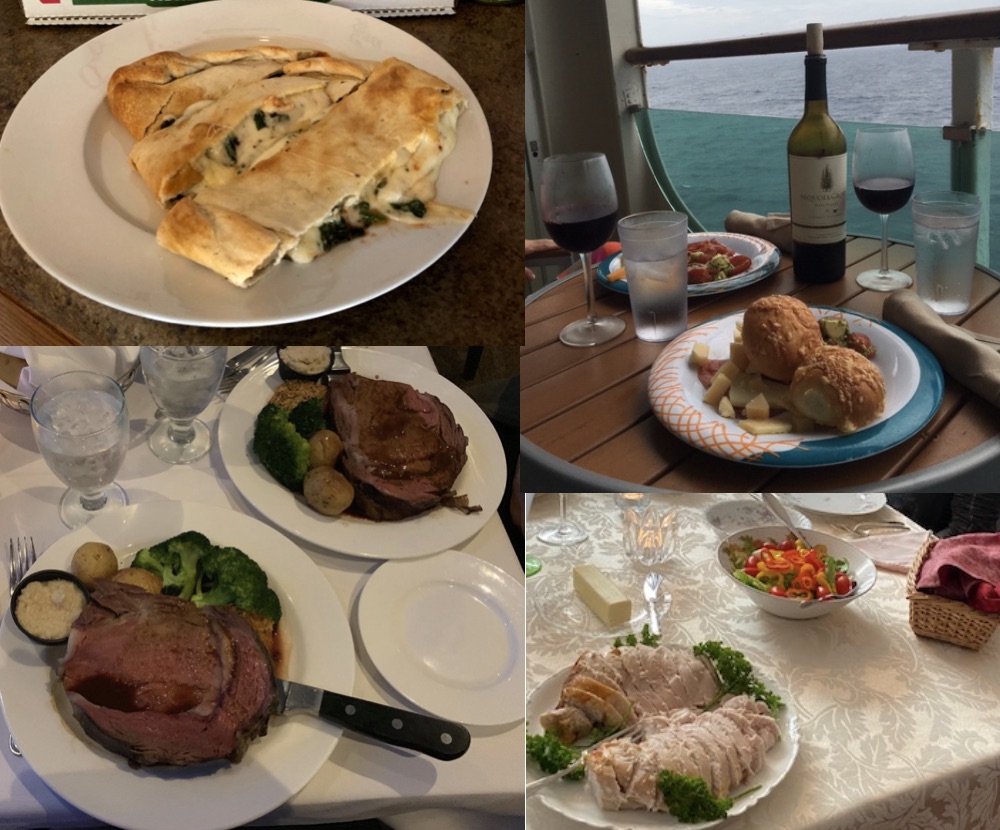
It is not easy to eat with a mask on. Though I have to be honest. I haven’t tried. Most of my meals have been prepared at home by…me. I continue to limit myself to carry out when I must satisfy those occasional cravings for a Double Butter Burger Basket from Culver’s or a spinach calabrese from Aurelio’s Pizza. My last meal out before quarantine was at Cortona’s in Fortville on March 15 after church with Elizabeth. Delicious Italian food. The only meal I have had out was to celebrate my youngest heading off to college. We went to a new Italian spot in Carmel called Savor because they had a very spacious outdoor dining area. Can you tell I have a taste for northern Mediterranean cuisine?

Speaking of food. I know that I am not the only foodie out there. I remember a delightful Birthday Dinner not too long ago in our fellowship hall. We like to eat. And I dream of the day where that meal with you all can happen again.

In the meantime, there are meals at home, alone, with my dog. My bi-weekly visits with my parents in Bloomington where I pick up something tasty to bring for lunch. This coming week is their anniversary and I am coming down for the evening and picking up from one of their favorite spots, Samira. And mine too! I thoroughly enjoy Afghan food. (Mom, you asked me for my order for Thursday. I want the Chicken Manto, please. Chicken manto is a steamed dumpling filled with chicken, white leeks, cilantro, topped with tomato-basil sauce and spiced yogurt. Divine.)

I am getting hungry with all this talk about fine food. It’s like when I read Ernest Hemingway. Here’s a writer that basically tells it like it is. Simple prose. Not much interiority to characters or psychological psycho-babble. But when Hemingway writes about food. Oh, my. My favorite book of his is even named after a food event, The Moveable Feast. I am all for moving feasts. Take this passage: “I asked for a distingue, the big glass mug that held a liter, and for potato salad. The beer was very cold and wonderful to drink. The pommes a l’huile were firm and marinated and the olive oil delicious. I ground black pepper over the potatoes and moistened the bread in the olive oil. After the first heavy draft of beer I drank and ate very slowly. When the pommes a l’huile were gone I ordered another serving and a cervelas. This was a sausage like a heavy, wide frankfurter split in two and covered with a special mustard sauce. I mopped up all the oil and all of the sauce with bread and drank the beer slowly until it began to lose its coldness and then I finished it and ordered a demi and watched it drawn. It seemed colder than the distingue and I drank half of it.” Oh, MY! It’s a wonder Hemingway could write after all that drink!

With all of this talk about food, I for one am very grateful that God lowered the divine menu from the heavens and said, Eat. Eat anything. Eat everything! Three times. Eat. Eat. Eat. (Remember, this is Peter so anything needs to be repeated three times for him to get it.) Does Peter get it?

For those of us who are currently wandering through the book of Acts in our Bible Study we know that Peter gets it. We also know that this vision, this dream, is NOT about food. Peter awakens from the trance and goes to the gentile Cornelius’ house. Peter is greeted. He begins by saying, You know that it is forbidden for a Jew to associate with or to visit a person of another race. Yes, they all know. And here’s the line where Peter shares with the world that he gets it: God has shown me not to call any person common or unclean. Peter goes on, In truth, I am grasping that God is no respecter of appearances. God is Lord of all!

I have fantastic memories of meals shared with…all. A meal with clergy friends to end a trip in Rome; a meal that began with mussels and ended with limoncello. Meals at my parent’s house as they hosted international students from all over the globe attending Indiana University; an operatic soprano from New Zealand, a Chinese couple in the business school, and a Swiss piano player that became like family. Many meals with Swedish cousins that stayed with us when I was in school. I remember Greek Easter meals at my aunt’s with the old men turning the lamb on the spit. I remember countless Cinco de Mayo’s. A meal with the Saysongkhams, a Laotian boat family that the church of my youth brought to the United States. A traditional Swedish Christmas Eve dinner with lutefisk and brunne benner and potataskorp. A seminary class on world Christian history where we ate at a different ethnic restaurant every week. And Thanksgiving, that always started with mussels and ended with the bouquet of asparagus throughout the evening hours.

A culinary delight for the taste buds and for the friendships and now family across the globe. I get it. Just like Peter got it. It is about food. And, it is so much more than just food. There is an ominous ending in today’s text. The New International Version that Steve read doesn’t do the ending to Peter’s dream justice. It reads, Immediately the sheet was taken back up to heaven. But the Greek word used for the sheet that comes down from heaven in verse eleven, othone, is NOT the word used in verse sixteen. Verse sixteen in the New Revised Standard Version reads, “The thing, skeous, was suddenly taken up to heaven.”

Something happens here. Something very, very important. An indication. A warning for our all-too-human and sinful natures. God lowers from the heavens a sheet with every animal on it. A sheet with every thing and every possibility. A sheet that declares, NO person is common. NO person is unclean. This beautiful vision of the universality of God’s love, grace, call it what you will, comes down from the heavens…and then the vision ends. The vision, the dream becomes…a thing. A thing. And what happens when people turn dreams and visions…and other people…into things?

…and the thing was suddenly taken up to heaven. Acts 10:16

Divine Deliverer, who brings down "something like a large sheet"
filled with "all kinds of four-footed creatures and reptiles and birds of the air",
a miraculous menu for all to consider,
voicing from above the earthly table,
“What God has made clean, you must not call profane,”
send more of that sheet,
as we failed, for the fourth time,
to read your writing in the heavens.
For upon its removal, the earthly author
turned
the dream of your holy arrangement
into a disappearing act,
even calling the dream,
"the thing."
Amen.

Table of Contents – What a Table!

A representation of table of Presence

So let’s begin with…what DOES the Table for the Bread of Presence actually look like? Keeping in mind that a cubit is the length from an elbow to one’s fingertips – give or take a finger – it looks maybe like this? Enough room for the twelve loaves of bread; each loaf representing a tribe of Israel. It’s a lovely table…if you’re into gold. Keep in mind, like any good artist designer, God’s tastes evolved over time and by the time Micah gets on the scene, God is more interested in mercy and not in the trappings that surround sacrifice.

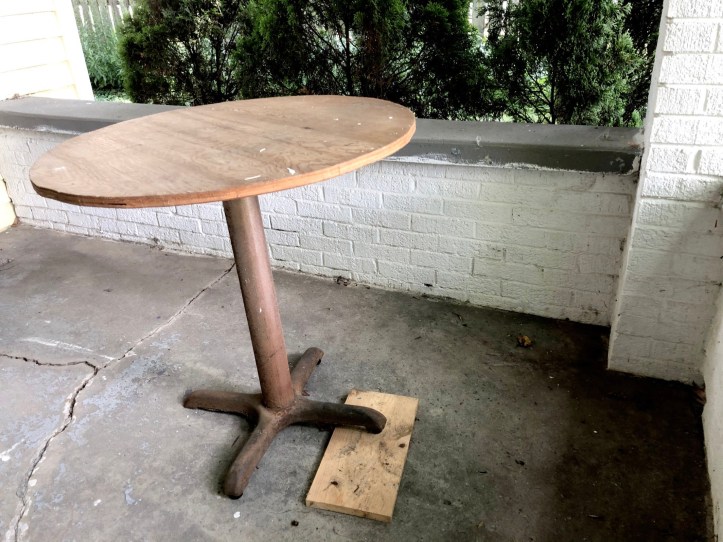
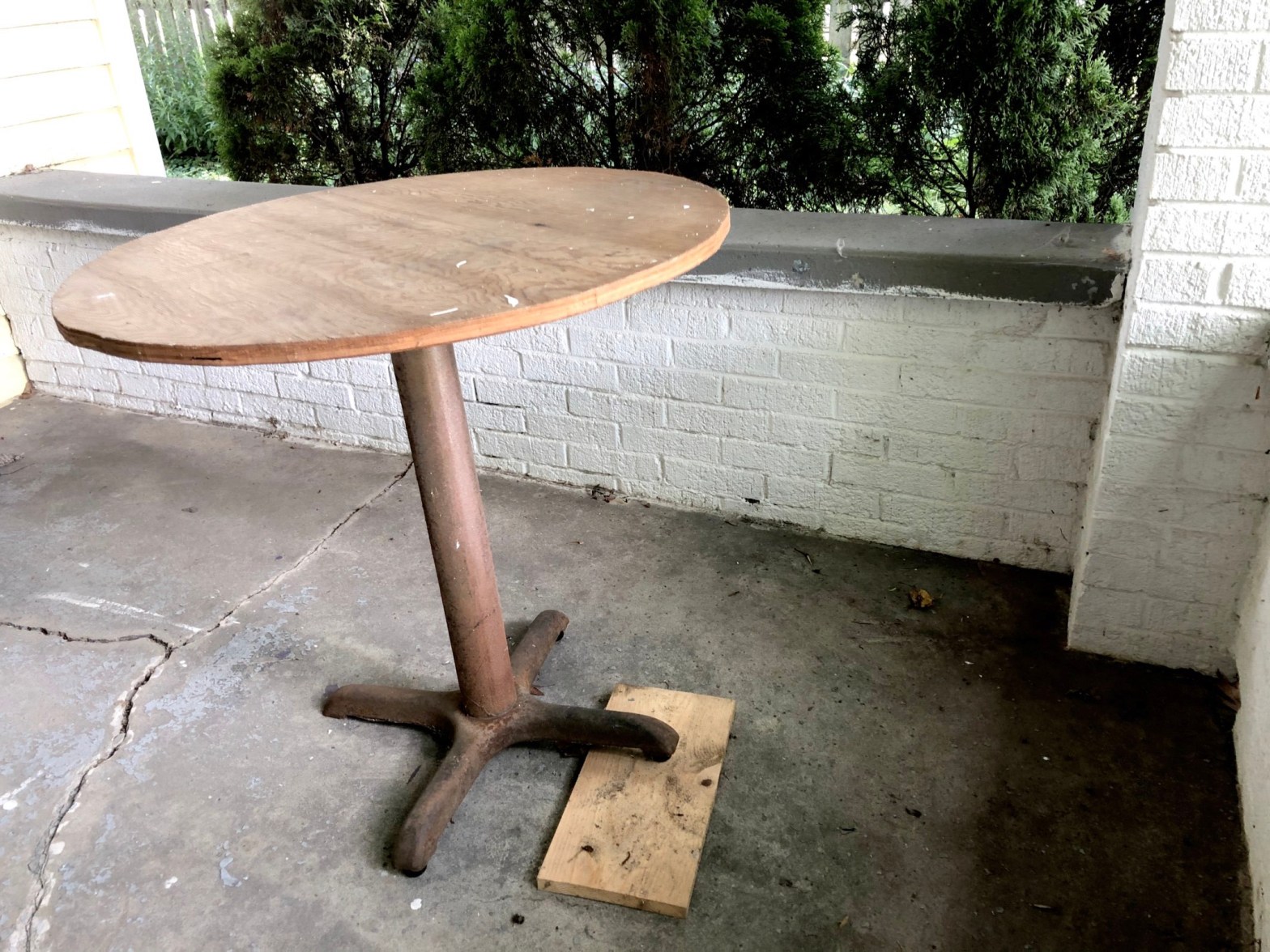
My “utilitarian” table

So, maybe my poor, little, front porch table – where the best thing that can be said about it is, “It certainly is utilitarian” – maybe my humble table is acceptable in the eyes of the Lord. So, I will not give in to comparison, which in the words of Teddy Roosevelt, is “the thief of joy.”

Instead, I will rejoice at sitting at THIS table!

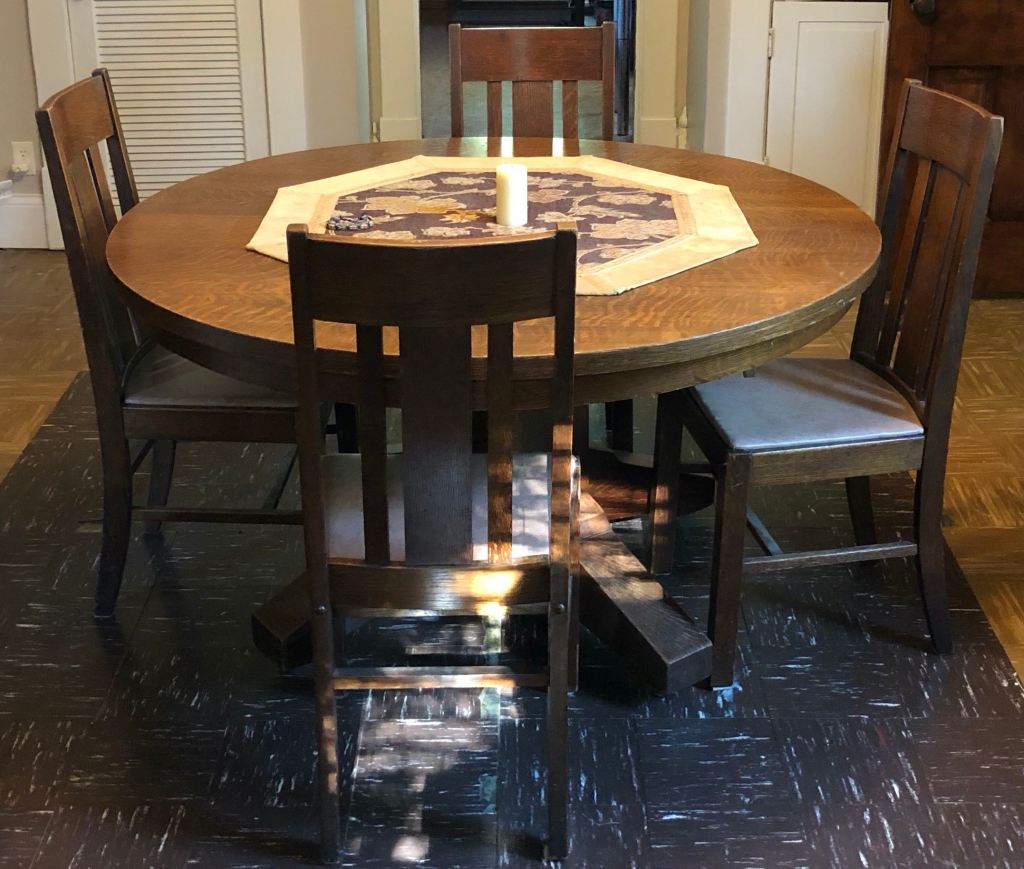
My inherited table

My dining room table which passed on to me from my great-aunt Phyllis Cole who received it in turn from her mother, my great-grandmother, Jennie Waggoner. It’s a lovely walnut table with buffet and can be stretched out from its present circular shape with six inserts so that twelve could sit comfortably around it. I understand that the table could, if Jennie didn’t sit at the end all by herself – closest to the kitchen, mind you – seat thirteen. But Grandma Jennie insisted to never seat thirteen at the table for obvious reasons. (To which my tongue-in-cheek response today is, Jennie, there were thirteen at the Lord’s table that fateful night.)

I sit here and imagine the people who have gathered around this table for holiday dinners and family meals. History’s times and events that unfolded in the newspapers spread across the table-top. This table was in Dixon, Illinois, in 1918 when the Spanish Flu pandemic swept through the world. I wonder the thoughts and worries of my great-grandfather, Harvey Garland Waggoner, as he sought to minister to his congregation during that time. And his thoughts about his five children and wife that surrounded the table with him.

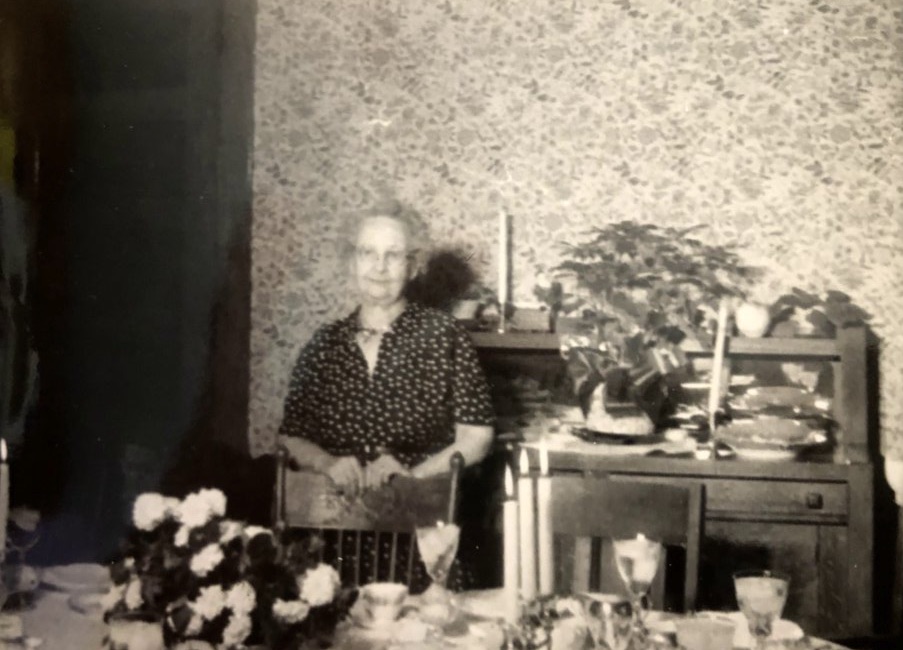
Did he have thoughts of his own mortality as he broke bread? He died in 1922 leaving Jennie to sit at the head of this table with her five children and watch alone as they grew up into their own lives. I imagine great-grandma Jennie in those times when she sat alone at this table, as I have often sat alone at this table. But then there are grandchildren and more children that come into the picture. New faces and children of God to sit at new places where familiar faces from the past once sat. Here’s a picture of Jennie at this table laid out for a Christmas dinner:

My great grandmother, Jennie Waggoner (late 1940’s?)

And now, eighty years later I am doing an online worship service at her table.  She would certainly understand about the adjustments needed in life due to a pandemic. Though she may be a bit puzzled at the technology of today that surrounds this process of broadcasting from her table, my guess is that she would understand that though times may change the purpose of the table remains the same: to make memories and to remember.

What tables do you remember? There was a picnic table that I built. My parent’s kitchen table and the formal dining room table that they received from my grandmother. Isn’t it funny how stuff gets passed along and the memories that trail along with each piece. My mom reminded me this week of what her mother said to her when grandma came to visit after moving out of her house in Eureka, Illinois to take up permanent residence in Florida. She would say, “I love to visit my daughters so I can see my furniture again.” So many tables.

And today, so much is coming to the tables of our lives. A pandemic that brings new meaning to the parental demand, “Wash your hands before coming to the table.” The keen awareness that our tables so sharply reflect the divide of race in our culture. The economics of today decide what is on each table and how different tables laden with food and drink actually are. And the politics talked around each table. Or, what is more probably the case, where politics are NOT talked around the table when the entire family is gathered.

Same table. Different people. Different fare. Although Jennie’s bran muffins will always be served at this table. Different world. Same table.

It is a fancy, golden table that God asks to be created for the forty-year wandering of the tribes of Israel in the wilderness. A fancy table created for the wilderness. My guess is this: it wasn’t too much trouble for the tribes of Israel to make the table that God asked them to create. God asks nothing more from us today as we wander through the current wilderness of our time. Make a table.

As we begin this four-week reflection upon the Table and Communion, my hope is for you to take the time to seriously consider what the Table looks like for you…for us…today. What does a table look like when we cannot physically gather around that table? Where does the “gold” that God asks to cover and surround the table come from? What is that gold? Here’s where I think the gold comes from: Your answer to the question, What tables can you create this week?

And you shall set the bread of the Presence on the table before me always. Exodus 25:30

Presence,
Giver of all presents,
presented on the table
is the bread of the Presence,
presently
uneaten.
If You are not going to eat it
can I have a bite?
Or, if my request smites you as selfish
might I share it with the hungry?
Amen.

Pause

Before we formally take a pause with today’s message I need to ask: Has anybody become an expert in living with this pandemic?  We are now five months in.  Surely that is enough time for some expert talent to develop.  I am going to put this week’s cover image on the screen and give all of you time to share any expert tidbits of wisdom and wise coping strategies in the comments section. Here we go…

The view from the pandemic…

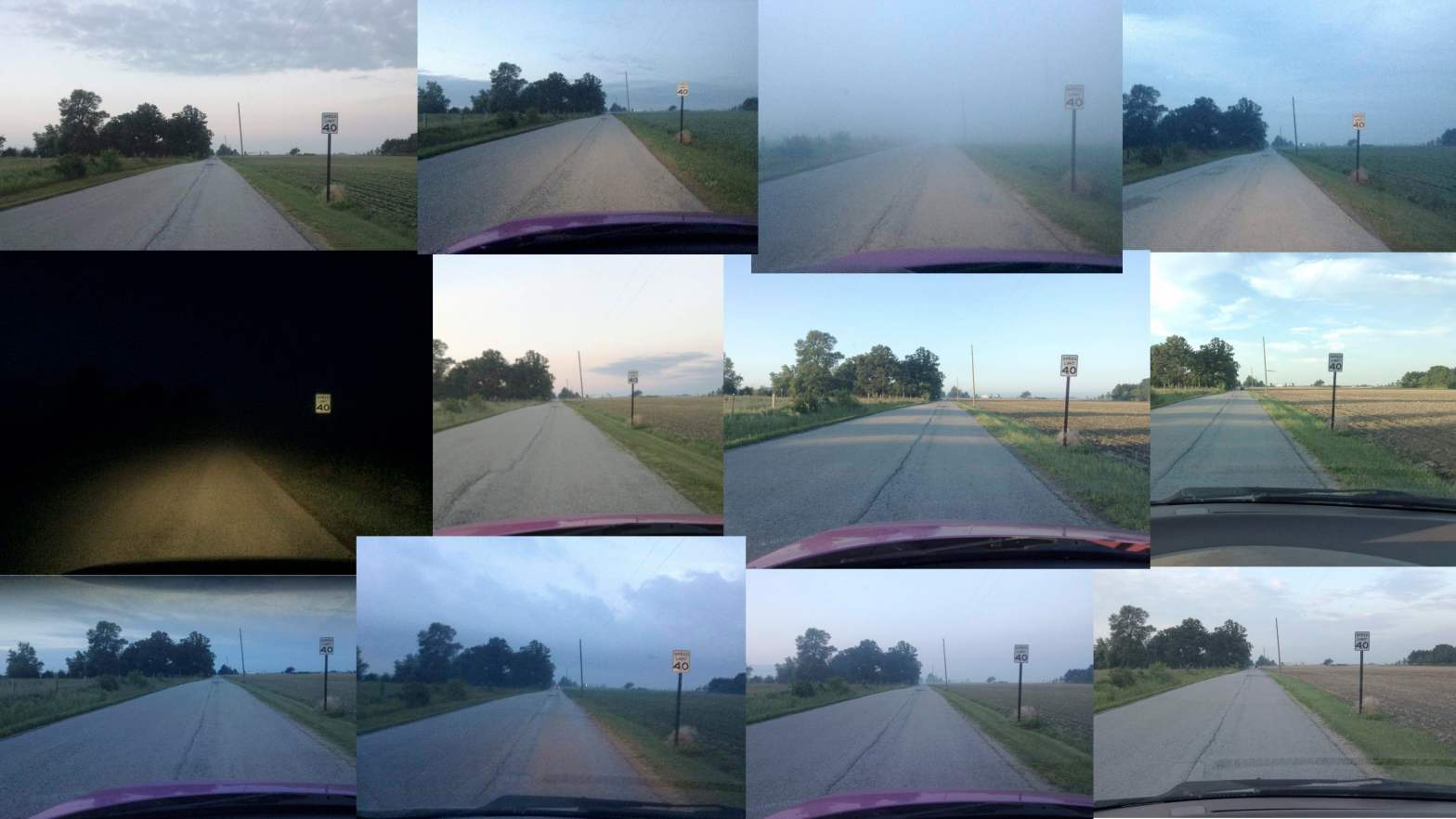
In 2014 I began taking daily pictures of a particular spot on my commute to work at Amazon.  This spot is on 300 W  just south of IN-32 which runs between Noblesville and Lebanon.  The first picture I found in my archives from the county road 300 W was from February 14. 

February 14, 2005, 300 W just south of IN-32

I think you can see why I stopped and took a picture.  With full disclosure of my sinful nature I must confess that sometimes I didn’t stop to take a picture.  “But officer, I wasn’t texting I was taking a picture of the beautiful sunrise over the icy fields.”  With Indiana’s change in law where it is now illegal to even have your phone in your hands while in the car I have become more attentive to stopping before picture-snapping.

On July 23 I stopped at a particular spot on 300W for the first time. 

July 23, 2005

A 40 MPH Speed Limit Sign on my right became my marker.  I don’t think I stopped there intentionally as if I had any conscious thought that this would be a great spot to take a picture every morning for the next six to eight months.  Look a little further down the road.  What do you see?  A pair of headlights coming right towards me.  I think I stopped for self-preservation and, in case there was some sort of evidence needed for insurance purposes due to a collision, I took a picture. CYA stuff.  Who knows – God only knows – maybe it would be the very last picture that I ever took if the possible, oncoming accident turned deadly for me.  (As an aside, one learned very quickly to be extra cautious driving to work as the previous 10-hour shift was leaving.  People were so darn out of it and drove with no awareness of the outside world after putting in a shift at Amazon.  I know, because at the end of my 12-hour shift – supervisor hours – I didn’t give an owl’s hoot how straight I drove north along 300 W.)

Day after day I would stop before the 40 mph sign and take a picture.  I did so for eight months never really knowing how or if I would “use” the pictures.  Until today. 

Sixteen pictures out of a couple hundred to use as a metaphor for life in a pandemic.  I certainly did not have THAT in mind, let alone using them as a sermon illustration some sixteen years later as an example of the day after day after day after day of now.

Surely some of us have become experts and perfected our pandemic wardrobes?  Menus and food preparation?  Circulating clothing and laundry?  Let’s see.  I put those shorts on after lunch yesterday.  Or was that two days ago?  Better wash them.  How is it that it feels like I am actually doing more laundry during the last five months than at any other time in my life?  I think the best decision I made was to buy six black t-shirts at the start of this crazy time; all organic materials, safe-dyes, manufactured by human beings – a small and intentional decision on my part to support local economies during this time.  If the shirt is folded than I haven’t worn it.  Put it on.  And it’s really easy for me to tell which black shirts have been previously worn because my dog’s favorite activity is to drag my shirts out of the laundry basket and bring them to her nest on the couch.

So, where in the world am I going with this?  I have no idea other than…to…PAUSE!

Pause.

Where are you now?  Do you know what day it is? Many of us are retired and not seeing much fluctuation in the days’ routine.  Some of us are working from home and…not seeing much fluctuation in the days’ routine.  Even those of us who have returned to a life closer to a pre-pandemic lifestyle, routine-ish?  Where is the “routine” in the midst of the largest three-month drop in economic output our country has ever seen?  Is there “routine” as 150,000 of our neighbors have died from COVID-19?  Will protests or riots or demands or calls for justice become “routine”?  One routine that hasn’t changed because of the pandemic is the inundation of election ads during this time of an election year; those ads would have been nice to have disappeared because of the pandemic.

For all that is going on around us, whether it’s our routine, our lack of a routine, the events of the world, the state of the pandemic, the craziness of different opinions – some scientific and some not-so-scientific – the worry of this parent (and I know that I am not alone) of a child going back to school. 

I think it is helpful to remember that we are all complicit in one way or another for the mess that we all are in.  Biblically speaking, we all took a bite of the apple and, as a result, are removed to some degree – some more removed than others – from the garden of bliss.

Here we are in the real world, a world turned upside down and around and about, needing…a pause…  Which if you think about it is like any other day of our lives, pre-pandemic or now.  Challenges.  To try and NOT get caught up in that first way of being in human community that scripture tells about after humans were removed from the garden of bliss.  Right away, humans got in to trouble.  Cain killed Abel.  Sometimes I think the whole condition of what it means to be human can be found in the second and third chapters of Genesis.  Bliss in the garden.  Bad choice.  Consequences.  Another chance.  Kill your brother and ask, “Am I my brother’s keeper?”  Consequences.  Another chance.  And that short story, powerful story, plays out over and over again, differently in each of our lives.

Pause. 

Let’s step outside that story for a little longer.  Yes, same road.  Same 40 mph sign.  Different weather conditions.  Different times.  What can WE control?  And, I LOVE these verses from Paul for giving us a focus for this time of pause and also a way of life for each and every day of our lives.

Take care of your bodies.  Constantly renew your minds.  Do NOT be conformed to this world but always transform your minds, your way of thinking so as to discern the will of God.  And do this, take care of your body and renew your mind, for the sake of the larger body of Christ of which we are all a part.

During this pandemic I have switched over from eating a daily banana to eating a daily apple for my body.  I have done this consciously, as a reminder with each bite of the fruit from the tree of knowledge of good and evil, to work for good in some small way each and every day.  And my mind?  My mind has never been more intensely and provocatively renewed as I read the black thinkers Ta-Nehisi Coates, Ibram X. Kendi and Resmaa Menakem and the white thinker Robin Di’Angleo, the black novelists N.K. Jemison and Octavia Butler and the black poets Gwendolyn Brooks, Marilyn Nelson, Claudia Rankine and countless other black poets.  And I do so because a large part of our body is crying out in pain from the bondage of injustice.

Take care of your body today and tomorrow and the next day.
Delight in the transformation that happens when you renew your mind.
And if you’re stuck in small ways or a bunch of big ways, ask for help.  Call me. 

Because as Paul also writes, there is a still more excellent way…

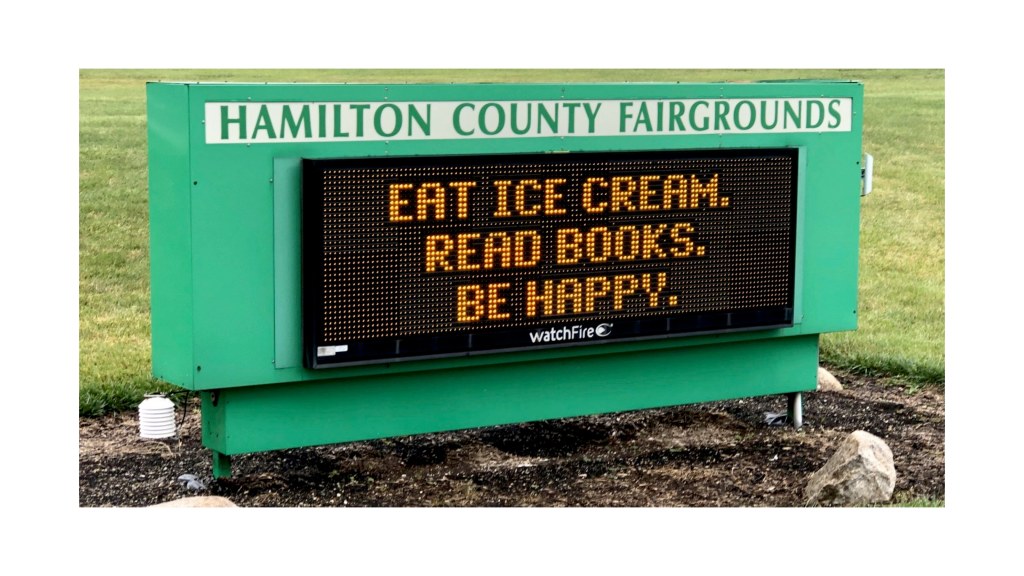
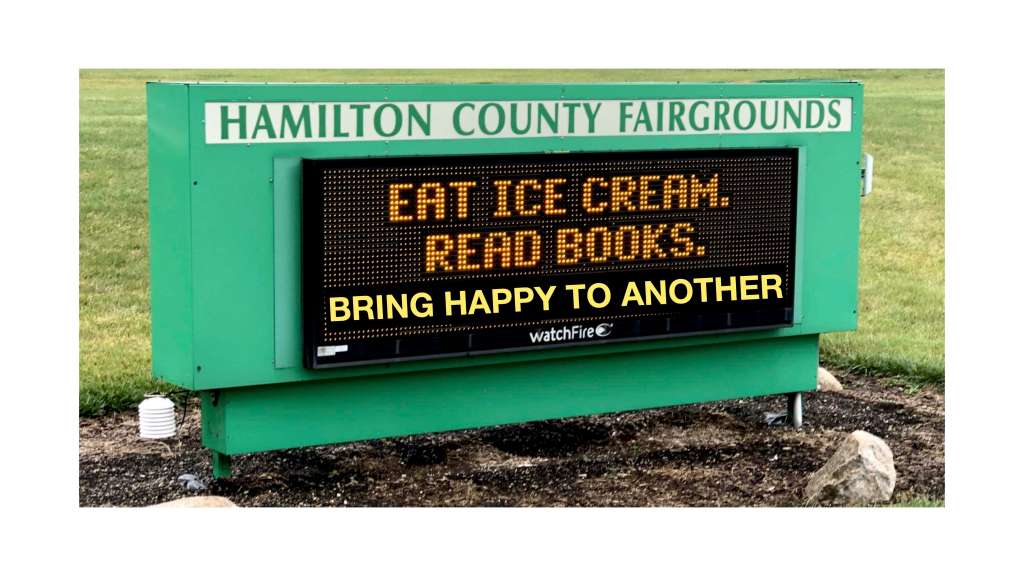
Wonderfully depicted this week on the marquis of the Hamilton County Fairgrounds – and, yes, I did stop the car to take this picture.

Eat ice cream.
Read books.
Be happy.

And with one small adjustment, you can read Paul’s very words…

Eat ice cream. Take care of your body.
Read books. Transform your mind.
Be happy to another person for we are all one body in Christ.

“…so that you may discern what is the will of God—what is good and acceptable and perfect.” Romans 12:2

Will-full, God,
who gives me the ability to discern your will,
is your will singular or plural?
Who is the "you" You are referring to?
For while I may be clear
on what is good and acceptable and perfect,
the plurality of "you",
the second persons plural,
them, those people and the Others,
discern a different good and acceptable and perfect.
Amen.

Salvation Story: Saved For…

Saved from Death.
Saved from Sin.
Saved from Self.
Saved from Meaninglessness.
Saved from Hell.

And since this is the last sermon in this series, perhaps some of you are thinking, Thank God, we are saved from another sermon by Reverend Eric about being saved.

I hope that after five weeks of wrestling with salvation – with what salvation meant for the early followers of Jesus Christ and with how the ideas about salvation have carried forward into today’s world – your appreciation for this rich, theological idea has grown, been challenged and, more importantly, that you are inspired to continue to be saved from death, sin, yourself, meaninglessness and from Hell.  We have heard a great deal from Paul’s letters about salvation in this sermon series.  Today’s reading from his letter to the Romans is the culmination, the endpoint and the main point, for Paul’s understanding of salvation found in Christ. 

Paul writes to the church in Rome, “For I am convinced that neither death, nor life, nor angels, nor rulers, nor things present, nor things to come, nor powers, nor height, nor depth, nor anything else in all creation, will be able to separate us from the love of God in Christ Jesus our Lord.”  Did you catch how Paul began this list of his?  Paul starts with, “neither death,” the place where he began in his earliest letter where he wrote about salvation to the Thessalonians.  And then Paul keeps adding to the list of those things that cannot separate us from God’s saving grace.  Ten things on Paul’s list.  (Just to think I could have preached a ten-part sermon series.)  “For I am convinced that neither death, nor life, nor angels, nor rulers, nor things present, nor things to come, nor powers, nor height, nor depth, nor anything else in all creation, will be able to separate us from the love of God in Christ Jesus our Lord.”

Nothing nor anything else in all creation will be able to separate us from being saved.  AND, this begs the question: If we are saved FROM everything, then what are we saved for?  If God is for us, then we are saved for…?  I have dropped some not-so-subtle hints in each of the sermons these past five weeks.  Along the way I have talked about pronoun usage.  If God is for us, then we are taken care of and we can stop worrying about us.  Me, myself and I?  We’re good.  Now, how about the second person singular and the second person plural, you and the others, and the third person singular and the third person plural, he/she/they/them?

The point of being saved is not to become a follower of Jesus and be able to say, “I am a Christian.”  That’s already taken care of.  In fact, the point of being saved is not to become a “Christian” but to become Christ-like.  There is a story of a young person seeking to evangelize an old and wise monk in a Greek monastery.  The young person comes up to the monk and introduces themselves saying, “I am a Christian.”  And before they could say anything else the monk replied, “Already?

That sort of puts one in their place.  And we need that as people who call ourselves, “Christian.”  To be reminded that the way of Jesus is a journey and not a destination.  Just as Paul is convinced that nothing can separate us from the love of God, I am also convinced that we don’t really believe that that is true.  How so?  Well, we keep thinking and believing and acting…small.  Most Christians think that being called a “Christian” and being a disciple and follower of Christ is what being a Christian is all about.

And, that is the first step.  Once you see the resurrected Christ in the garden where it all begins outside the tomb, we are told to return to Galilee, where the story of Jesus all began.  Why?  Not to read it again as one of the disciples.  You did that the first time through to become a disciple.  Now, read the story again to do what Jesus did; to become Christ-like.

Take the only miracle story that appears in all four gospels.  Yes, of all the miracles and stories about Jesus’ ministry, there is only one that is found in all four gospels.  The feeding of the five thousand.  What happens?  The people have been following Jesus all day.  It’s supper time.  The people are hungry and tired.  The disciples say to Jesus, “Send them away for they are hungry.”  And Jesus replies, probably with a roll of his eyes, “You give them something to eat.”  But we don’t have anything.  And what happens?  Bread and fish make a meal.  Okay, okay.  This is our first time through your story, Jesus, we understand. 

What happens the next time we go through the story?  What role do you see yourself in the second time through?  Or is there a third time and a fourth time?  At what point do we see and learn that we are supposed to be like Jesus and BE the ones to give them something to eat?  Jesus tells us, “YOU give them something to eat.”

To do what Jesus did.  To become Christ-like.  That’s the saved for! 

Our Bible study group is wandering through the Book of Acts and we are reading about how Peter and Paul and others “get it” and do what Jesus did.  They go to those in need.  They eat with them.  They heal them.  They resurrect them.  We are called to do the same thing for…them.  And it grieves me that the rapid decline in Christianity in the West, in the United States, is not due to the demonic forces keeping people away from the love of God.  We know, from Paul, that that can’t happen.  It grieves me that we have made the Christian faith so…small…and personal…and selfish…and most people see right through that in this day and age.

We are not saved for…us.  We are saved for…everything and everyone else.

What then are we to say about these things? – Romans 8:31

God who cried pain
into the universe from the cross
and who,
after breaking yourself apart
at the very beginning of time
pealed to the heavens, "I AM,"
and who,
after finishing the early work of creation
declared, "It is good!"
make the words in our mouths
so we may say
something
about these things
that make heaven on earth
...intricate and awkward and grim.
Amen.