We heard last week how Peter's first sermon to the in-crowd - the believers - did not get any response.  No cheers.  No thousands clamoring to be part of the next "new" thing.  Not surprising.  These guys hung out with a convicted person executed for treason.  (And, yes, they are guys.  Women are starting to be written out of the early Christian narrative.)  Who wants to hang with THAT crowd?  And Peter's choice of topic in that first sermon?  "We need to replace the betrayer who, as a reward for his wickedness, tripped and fell in the field he purchased with the blood money of betrayal and he burst open in the middle and all his bowels gushed out."  Where do I sign up?

Fast forward to this Sunday's scripture reading which immediately follows Peter's first sermon to the out-crowd; which at this point consists only of fellow devout Jews who are in Jerusalem for the Festival of Shavuot, i.e. Pentecost.  Peter begins, "Men of Judea..."  (See previous note on gender.)  After some "skillful" exegesis of scripture - I would call it proof-texting - and some questionable rhetoric - I would call it weak hermeneutics - there is a clamorous response of 3,000 persons.  (Where does one baptize 3,000 men in one day in Jerusalem?)  "Men, what should we do?" the men ask.

And like every good (and bad) preacher, teacher and leader has done before him and after him, Peter makes his first mistake with his answer.  "Repent, and be baptized every one of you in the name of Jesus Christ so that our sins may be forgiven; and you will receive the gift of the Holy Spirit...Save yourselves from this corrupt generation."

Actually, Peter makes a BUNCH of mistakes.  Those of us in yesterday's Bible study were part of the discussion around one of the mistakes; a pretty significant one.  Compare Peter's first words in this passage with Jesus' first words in Mark 1:15.

More "fun" to come in Sunday's message.  The point being: Mistakes happened in "The Old Normal" which brought us to this mess that we are in.  And mistakes will happen in "The New Normal."  My hope for things unseen is a hope that - at the very least - the mistakes are different than those already made.
Monthly Archives: April 2020
Now when they heard this, they were cut to the heart… Acts 2:37
O, Divine butcher,
splitting our breastbones
wide open to get to
the guts of our heart,
give us ears to hear
the clean cut
of the sharp edge of truth
for fat of ugly lies
lies heavy on us.
Amen.
Sugar Molasses Spice Cookies

After breakfast I found myself out in the section of my yard where dandelions and violets are in abundance.  I spent a fair amount of time dead-heading the dandelions - a new COVID-19 ritual - to keep the fuzzy, albeit lovely, poofballs of seeds to a minimum.  I have found the morning to be the ideal time to do that because the poofballs have not opened up to the day's air...and to the breeze that bloweth where it will.  I like to see the happy bees moving from flower to flower.  I like to relish the fact that I don't care if my neighbors prefer all-green lawns.  My spot of yard is colored with yellow and violet and that rarer white-violet.  And it is lovely...

Another reason why this morning reflection is a bit later than usual is I got caught up in a powerful and engaging TED Talk given by BJ Miller, a hospice and palliative medicine physician.  Given in 2015, the Talk resonates with my/our conditions today.  What makes for a meaningful moment in life?  The conditions in which Miller works are fundamentally not much different than the conditions in which we find ourselves.  The wisdom he shares from experience is poignant and moving.  It re-affirmed my sense that "normal" let alone "The New Normal" is whatever we make a moment out to be.  He affirmed my notion that an aesthetic that engages the senses is the most robust and dynamic way to affirm a person's humanity, an other's humanity and my own.

AND, Miller gave me a dietary revelation, one which I tend to adjust this afternoon.  Miller says, "Seriously, with all the heavy-duty stuff happening under our roof, one of the most tried and true interventions we know of, is to bake cookies."

Have a bake-full day...
World Without End
Day 43.  Seven weeks ago on Monday, March 16, the stay-at-home order became effective (in Indiana) and all non-essential public spots were closed.  The previous day FCC (First Christian Church, Kokomo, Indiana) had just completed our first Facebook LIVE service which I watched that afternoon with my computer on its side.  Lunch on Sunday was at an immediate new favorite, Cortona in Fortville, and was our (Elizabeth and I) last meal out before distancing.

There is a pressing urge from many interests - individuals, groups and institutions - to "open up" and return the economy and our way of life towards "normal."  I celebrate that desire for normalcy!  Though I do so with one question and one statement.  Question: What was/is/will be normal?  Statement: If pre-pandemic was "normal" then it was that "normal" that got us into this horror in so many and varied ways.  I agree wholeheartedly with the patriarch of the Addams Family, Charles Addams, who said, "Normal is an illusion.  What is normal for the spider is chaos for the fly."

And so, to avoid a bit of despair, to find some hope for a "new normal" - and to simply learn from the early saints - I turn to scripture and find some peace in a line from this coming Sunday's scripture reading:  Acts 2:46 - Day by day, as they spent much time together in the temple, they broke bread at home and ate their food with glad and generous hearts, praising God and having the goodwill of all the people."

..as it was in the beginning is now and ever shall be, world without end.  Amen
What Does This Mean?
Online Sermon delivered April 26, 2020
for First Christian Church, Kokomo, Indiana
Where do you put yourself in this story?  Are you amazed and perplexed and asking the question, What does this mean?  Or are you a sneer-er saying, They are filled with new wine.

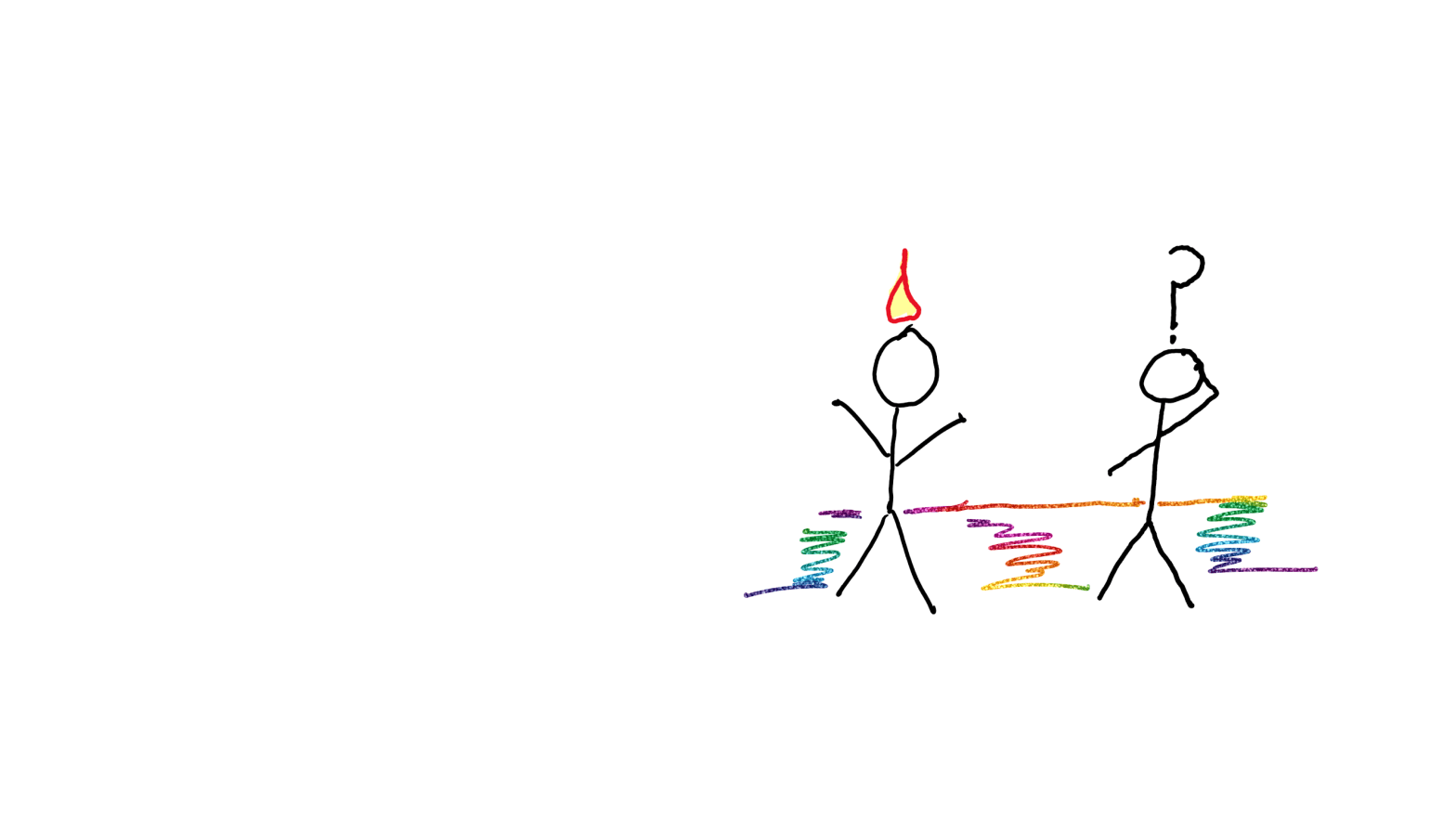
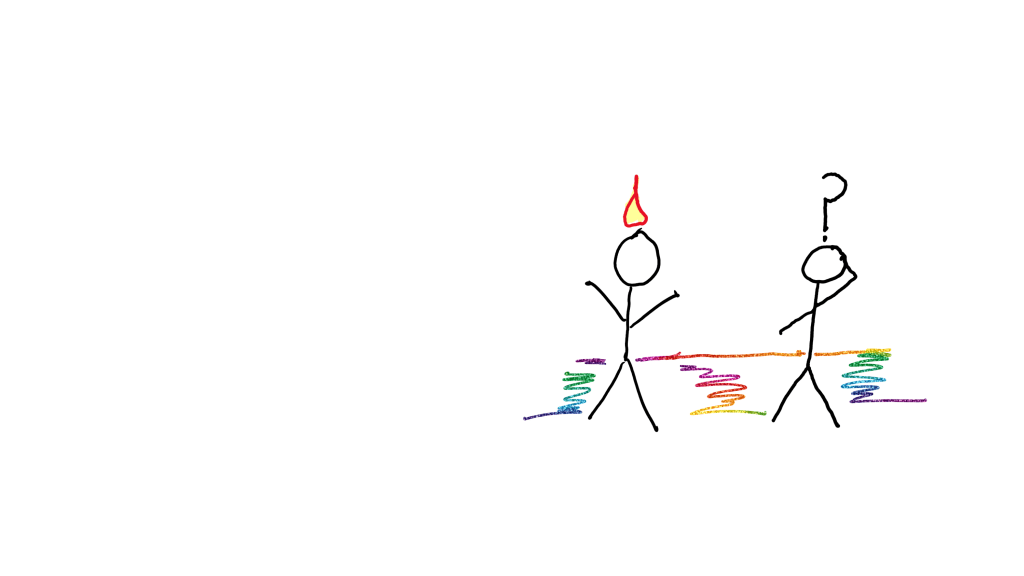
Though I had a playful bit of fun using stick figures to tell this story of the early church, today's scripture asks important questions for which the text demands serious answers.  Here is the beginning of the church 2,000 years ago.  And the first question asked of the church is "What does this mean?"  The first commentary on the first church, "Oh, they are filled with new wine."

2,000 years later...guess what?  The Pentecost event happens each and every day in the life of the church.  It is particularly poignant and powerful for us today.  Life is radically different.  We are gathered together...though each in our own dwelling place.  That's okay.  The Holy Spirit can divide and find us no matter where we may be.  The question is, where are you in the story today?  Are you amazed and perplexed and asking the question, What does this mean?  Or are you a sneer-er saying, They are filled with new wine.  And probably, bad new wine at that.  Or, there is the third character in the story: are you filled with the Holy Spirit?

People all around us are scratching their heads with what they hear.  I certainly am a head-scratcher when it comes to all of the information about COVID-19 and how best to go about living life.  I am dismayed at individuals and institutions that push the envelope of safety in the midst of the unknown.  I sneer at them and say, They are most definitely filled with new wine.  I go on to say to those drinkers of selfishness and greed and carelessness, "By drinking that new wine you are endangering the lives of people that I hold dear, the least of these, those most at risk."  But don't get me preaching...

Our being closed for gathering at the corner of Malfalfa and Sycamore does not make First Christian Church any less church.  We are no less church for me now then our church was before the pandemic.  Our worship services have never been better attended than now.  (If that's how you judge church effectiveness.)  More importantly, we are not worshiping apart today out of any sense of fear.  Fear at the possibility of becoming infected by exercising our religious freedom.  I am still free and worshiping how I am called to worship in this time.  And that is the question.  "What does this mean?" becomes "How am I called to worship in this new and different time?"  Here is my response to What does this mean?  Love for my neighbor and taking care of the least of these by not increasing the possibility of exposure by being out and about unnecessarily...that love is far greater than any need to be in a building with others for worship at this time.

Am I filled with new wine in the eyes of others?  Probably.  But I know this: I am on the side of love for my neighbor over anything else.  And I have faith that God is as well.  And those who speak my language in this moment are telling me that that love is best shared from a distance.

The earliest church, the first church of those twelve apostles, was NOT a church because they were together, scared, alone, in one house.  The earliest church did not immediately set about worshiping God.  Nor to worship Jesus.  Jesus never said to worship him.  The earliest church, the first church, was A church because they made themselves heard by speaking the language of the other.  Let me invite you into a secret: speaking the language of the other does not require a building.  The house where the first church spoke, wasn't even the apostles' house.

But, Eric, I don't know how to speak Cappadocian or Parthian.  I don't know how to speak the language of the Medes, the Elamites or the Mesopotamians.  I don't know the language of the Judeans or that of the people of Pontus or Asia, Phrygia or Pamphylia.  Egyptian and Libyan, indeed the language of Rome and the Creetans and the Arabs are completely unknown to me.

Perhaps.  There is...though...one language that IS universal to all others that we as the first church of today can continue to speak.  You will be able to understand it.  You have heard it before.  You have spoken it before and can continue to speak it again.

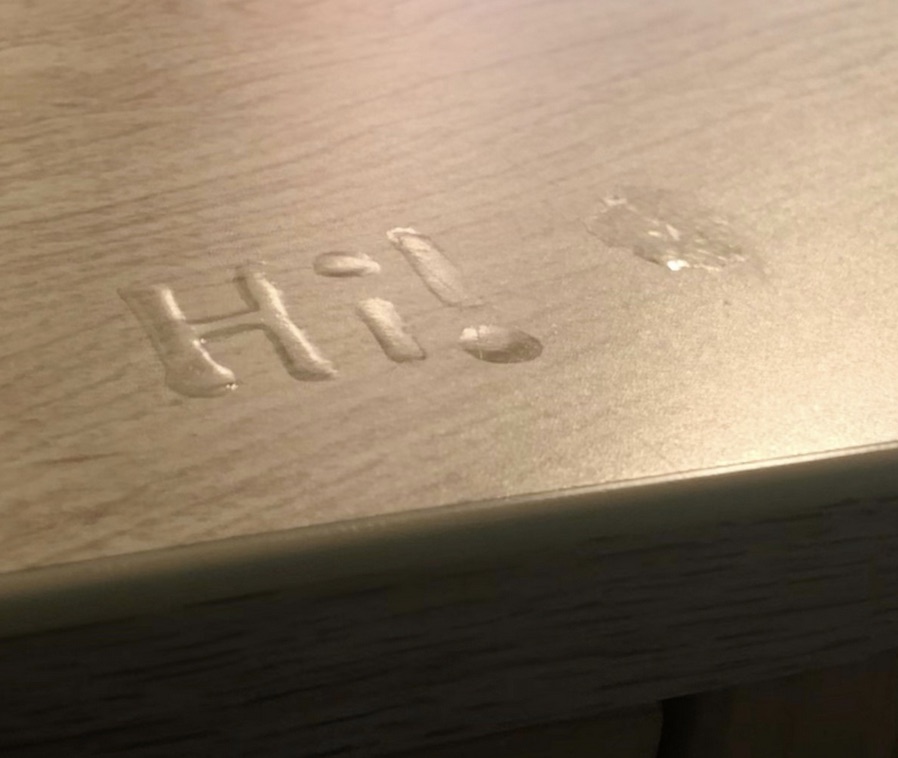
This language crosses to the other side of the Jericho Road to help a stranger in need.  This language steps in front of stones being thrown at a woman condemned.  This language heals the blind.  This language feeds thousands.  This language unbinds the manacles and chains that keep a man naked and insane in the local cemetery.  This language resurrects a daughter.  And a son.  And a brother.  And a friend.  This language crosses to the other side of the river where "they" live.  This language overturns the tables in places of worship that do not look out for the least of these.  This language holds the widow and celebrates her contribution to the realm of God.  This language collapses coliseums and erodes the power of empires.  When all appears lost, this language appears outside a tomb in a garden, saying, "Hi."

This language is the language of Love.

- Rev. Eric J. Brotheridge
“…a sound filled the entire house…” Acts 2:2

Creator of the Universe
filling an entire house
with the whoosh of yourself.
Is there a rush of wind
in your absence?
A withdrawal that
sucks the life out of us?
Leaving us empty
and staring
at the empty rooms
where we thought
there had been something
just a moment before.
Whoosh me
for I need wooshing.
Amen.
“…will do greater works than these…” John 14:12
Doing God,
living, dying and living again God,
do you "do" us?
Like, if we don't "do" it
then your will "does" not get "done"?
If so, "do" us
because so many
don't "do" anything.
Amen.
Suddenly Jesus met them and said, “Greetings!” Matthew 28:9

God of the Garden Tomb,
Mover of earth and stone and air,
Speaker of "Hello",
in the morning and
in our mourning
you step out and greet us
as if we were neighbors
stepping out to get our mail
after a long day of work.
Make "Hello" natural again
because we don't know each other.
Amen.
“…and when he had looked around at everything…” Mark 11:11
God
whose glance covers the cosmos
with attention
give us a gaze that aspires to leave nothing out
of the order and chaos that surrounds us
for the sucking void hides what can be precious
Amen
Let’s Remake the World by Pedaling Faster
…after Gregory Orr
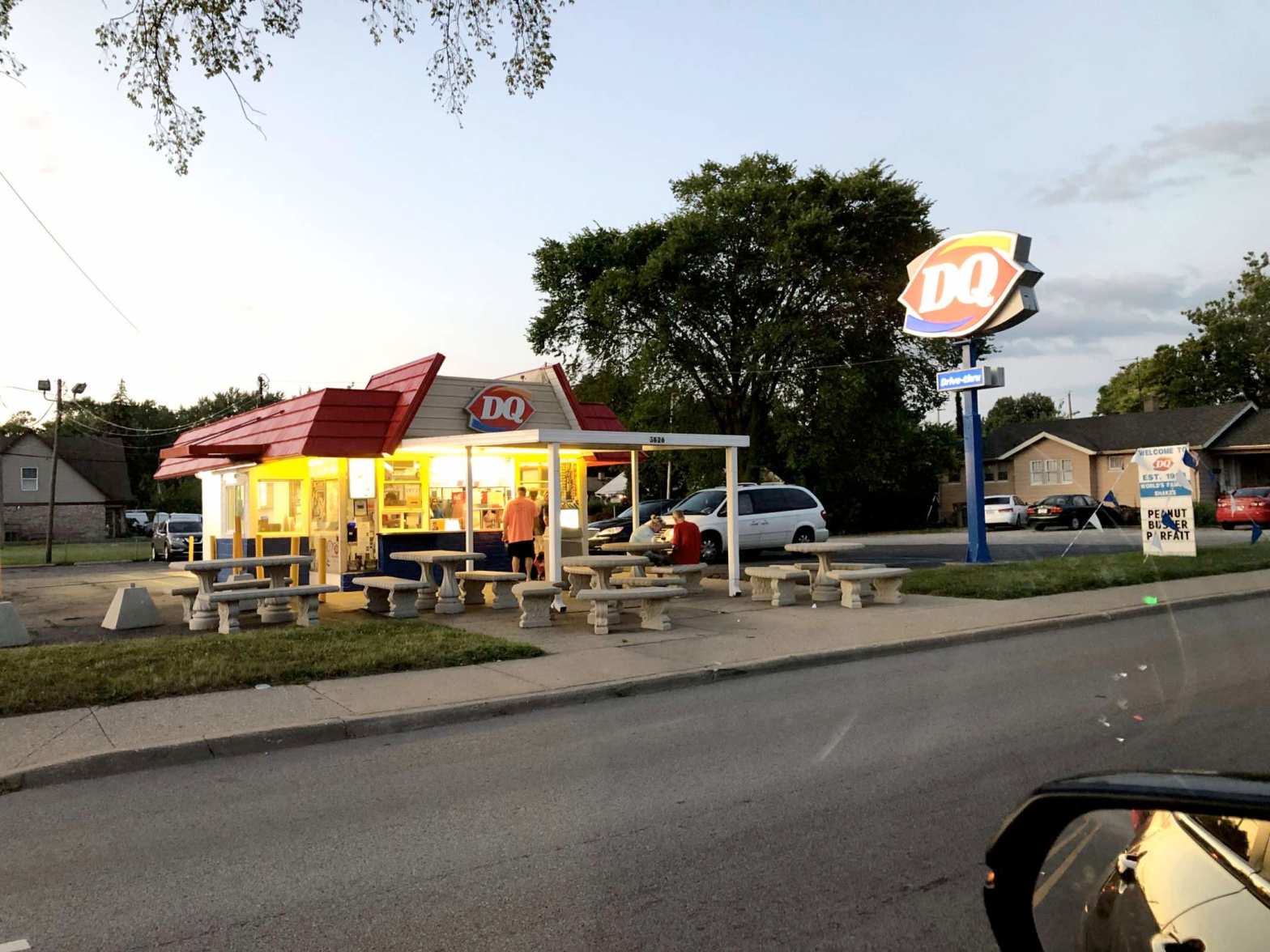
Let’s remake the world by pedaling faster
because the Dairy Queen can’t wait
at the end of our bicycle ride.
And the smiles speed brings
to the faces of my daughters
pulled along behind me
makes the circling madness
of my legs make sense.
Let’s “Go faster, Daddy!
so fast that our hair,
rushing behind us,
can’t catch us
and won’t get stuck
in the ice cream.”
Published: https://www.thewell.world/about/news/2020/04/08/mindful-poetry-virtual-gathering-2
 A Thread You Follow